
Although it is found in many pickups and SUVs, the 4.0-liter V6 Toyota 1GR-FE engine is most well-known for the Land Cruiser Prado. It has been manufactured in factories in the USA and Japan since 2002. This power unit comes in two generations: VVT-i and Dual VVT-i type phase regulators.
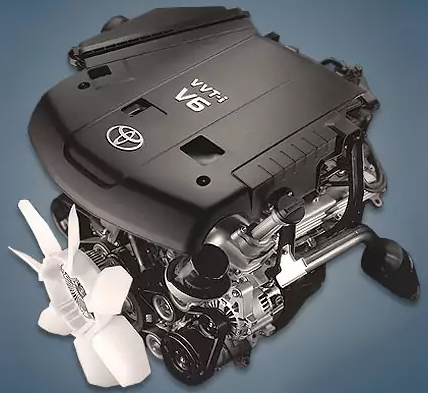
A new 4.0-liter engine made its debut on the Land Cruiser Prado 120 SUV in 2002. This engine’s 60° camber angle makes it a classic V6 engine for its era. It features a timing chain drive, aluminum DOHC cylinder heads without hydraulic lifters, an aluminum block with an open cooling jacket and cast-iron sleeves, and distributed fuel injection. Only the intake shafts of this motor’s initial generation had VVTi phase shifters.
The Land Cruiser Prado 150 SUV, which debuted the second generation of the unit in 2009, differed primarily in that all camshafts already had VVTi phase regulators. Additionally, hydraulic valve clearance compensators were included in the majority of motor modifications.
The engine was mounted on:
- Toyota 4Runner 4 (N210) in 2002 – 2009; 4Runner 5 (N280) since 2009;
- Toyota FJ Cruiser 1 (XJ10) since 2006;
- Toyota Fortuner 1 (AN50) in 2004 – 2015; Fortuner 2 (AN160) since 2015;
- Toyota Hilux 7 (AN10) in 2004 – 2015; Hilux 8 (AN120) since 2015;
- Toyota Land Cruiser 70 (J70) since 2009; Land Cruiser 200 (J200) in 2007 – 2021; Land Cruiser 300 (J300) since 2021;
- Toyota LC Prado 120 (J120) in 2002 – 2009; LC Prado 150 (J150) since 2009;
- Toyota Tacoma 2 (N220) in 2004 – 2015;
- Toyota Tundra 1 (XK30) in 2005 – 2006; Tundra 2 (XK50) in 2006 – 2021.
Specifications
| Production years | since 2002 |
| Displacement, cc | 3956 |
| Fuel system | distributed injection |
| Power output, hp | 230 – 250 (single VVT-i) 250 – 285 (Dual VVT-i) |
| Torque output, Nm | 365 – 380 (single VVT-i) 365 – 390 (Dual VVT-i) |
| Cylinder block | aluminum V6 |
| Block head | aluminum 24v |
| Cylinder bore, mm | 94 |
| Piston stroke, mm | 95 |
| Compression ratio | 10.0 (single VVT-i) 10.4 (Dual VVT-i) |
| Timing drive | chain |
| Phase regulator | VVT-i on intake shafts Dual VVT-i |
| Turbocharging | no |
| Recommended engine oil | 5W-20, 5W-30 |
| Engine oil capacity, liter | 5.3 (single VVT-i) 6.3 (Dual VVT-i) |
| Fuel type | petrol |
| Euro standards | EURO 3/4 (single VVT-i) EURO 5 (Dual VVT-i) |
| Fuel consumption, L/100 km (for Toyota Land Cruiser Prado 2007) — city — highway — combined |
16.7 9.8 12.4 |
| Engine lifespan, km | ~500 000 |
| Weight, kg | 166 |
Disadvantages of the 1GR-FE engine
The most frequent reason for contacting the service station is a cylinder head gasket failure following a severe engine overheating. This is a dependable unit with no design flaws. After the intake system was redesigned for the second generation of engines, this issue vanished.
Owners frequently hear the phase regulators crackling when they start their cars, but many continue to drive in this manner even though the clutch is broken and the vehicle is unstable. The couplings’ service life is extended by the phase regulators’ filter grids.
Contamination of the throttle assembly, injectors, and occasionally the fuel filter in the tank is the primary cause of floating idle and unstable engine operation. Additionally, the soured secondary air supply valve is the problem on the second generation.
A pump, short-lived coils, an ineffective crankcase ventilation system, and lambda probes that are sensitive to gasoline quality are further drawbacks. Remember to adjust the valves; many motor versions lack hydraulic lifters.