
From 1999 to 2007, the company produced the 2.0-liter Toyota 1CD-FTV or 2.0 D4D engine, which was installed on well-liked middle-class models primarily for the European market. This power unit had fuel equipment made exclusively by Denso.
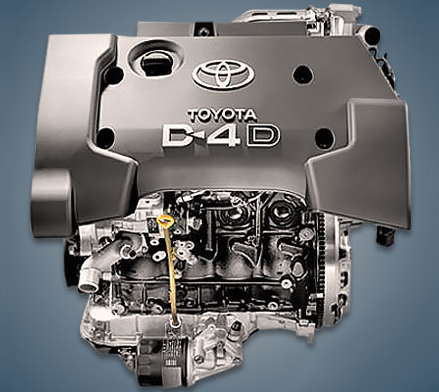
Fuel equipment was supplied by the renowned Japanese company Denso, and this power unit became the company’s first diesel engine with a Common Rail system. This engine comes in two versions: one with a traditional turbocharger that produces 90 horsepower and 215 Nm, and another with a variable geometry turbine and an intercooler that produces 110–116 horsepower and 250–280 Nm.
As usual, the four-cylinder, in-line cast iron block has no repair dimensions. The aluminum cylinder head has sixteen valves without hydraulic compensators; the choice of shims controls the valves’ thermal clearances. Additionally, a belt with a hydraulic tensioner performs the timing drive.
The engine was mounted on:
- Toyota Avensis 1 (T220) in 1999 – 2003; Avensis 2 (T250) in 2003 – 2006;
- Toyota Avensis Verso 1 (XM20) in 2001 – 2006;
- Toyota Corolla 8 (E110) in 2000 – 2002; Corolla 9 (E120) in 2001 – 2007;
- Toyota Corolla Verso 1 (E120) in 2001 – 2006;
- Toyota RAV4 2 (XA20) in 2000 – 2006;
- Toyota Previa 2 (XR30) in 2001 – 2006.
Specifications
| Production years | 1999-2007 |
| Displacement, cc | 1995 |
| Fuel system | Common Rail |
| Power output, hp | 90 – 116 |
| Torque output, Nm | 215 – 280 |
| Cylinder block | cast iron R4 |
| Block head | aluminum 16v |
| Cylinder bore, mm | 82.2 |
| Piston stroke, mm | 94 |
| Compression ratio | 17.8 – 18.6 |
| Hydraulic lifters | no |
| Timing drive | belt |
| Turbocharging | yes |
| Recommended engine oil | 5W-30, 5W-40 |
| Engine oil capacity, liter | 6.7 |
| Fuel type | diesel |
| Euro standards | EURO 4 |
| Fuel consumption, L/100 km (for Toyota Avensis 2002) — city — highway — combined |
8.0 4.8 5.9 |
| Engine lifespan, km | ~300 000 |
| Weight, kg | 205 |
Disadvantages of the 1CD-FTV engine
The primary fuel equipment malfunctions are related to injectors, which rapidly deteriorate from abrasive wear brought on by impurities in diesel fuel.
The fuel supply to the high-pressure fuel pump is adjusted by two unique SCV valves, which over time are prone to leaks. The engine stalls or refuses to start after the idle speed first begins to float.
The most well-known flaw in the power unit is the oil pressure sensor. Eventually, the ECU abruptly begins to indicate that there is insufficient lubrication, even though this is untrue. Replacement is the only way to drastically resolve the issue.
At high mileage, the EGR valve frequently clogs and freezes in one position. This initially manifests as a decrease in power before the engine enters emergency mode.
Many Toyota vehicles have an unreliable water pump, and this diesel engine is no different. Even on runs of fifty to sixty thousand kilometers, it can leak.