
The 1.8-liter Hyundai G4GM engine was built in a South Korean factory between 1995 and 2000. It was fitted to the Lantra’s J2 body and the Coupe that was based on it, but only prior to restyling. This motor is the rarest of the entire line because it wasn’t installed in every market.
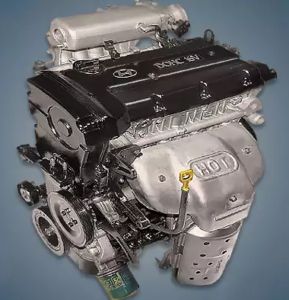
The engines in the Beta family are G4GR, G4GB, G4GM, G4GC, and G4GF.
The engine was mounted on:
- Hyundai Coupe 1 (RD) in 1996 – 1999;
- Hyundai Lantra 2 (RD) in 1995 – 2000.
Specifications
| Production years | 1995-2000 |
| Displacement, cc | 1795 |
| Fuel system | distributed injection |
| Power output, hp | 128 – 132 |
| Torque output, Nm | 165 – 170 |
| Cylinder block | cast iron R4 |
| Block head | aluminum 16v |
| Cylinder bore, mm | 82 |
| Piston stroke, mm | 85 |
| Compression ratio | 10.0 |
| Features | DOHC |
| Hydraulic lifters | yes |
| Timing drive | chain & belt |
| Phase regulator | no |
| Turbocharging | no |
| Recommended engine oil | 5W-40 |
| Engine oil capacity, liter | 4.0 |
| Fuel type | petrol |
| Euro standards | EURO 2 |
| Fuel consumption, L/100 km (for Hyundai Coupe 1997) — city — highway — combined |
10.7 7.8 8.9 |
| Engine lifespan, km | ~320 000 |
| Weight, kg | 135.6 |
Disadvantages of the Hyundai G4GM engine
It’s best to avoid cutting lubrication because the hydraulic lifters will knock even before 100,000 kilometers; the units from the first years had issues with build quality and some components;
Every 60,000 kilometers, the timing belt is changed, but if it breaks sooner, the valves will bend;
After 200,000 kilometers, wear on the rings and caps frequently results in oil consumption; in this case, the exhaust manifold frequently cracks, and there was even a recall campaign.