
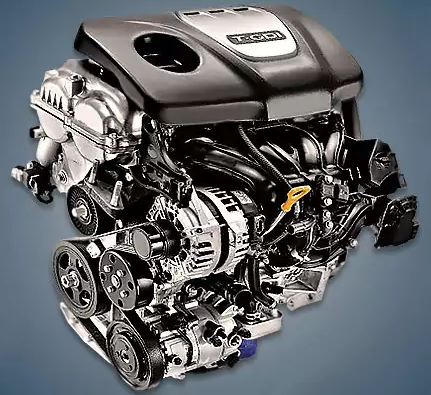
Since 2011, the Hyundai G4FJ 1.6-liter turbo engine, also known as the 1.6 T-GDI, has been manufactured in Korea and is found in popular models like the Sportage, Tucson, Ceed, Seltos, Kona, Veloster, and Soul. Turbocharging and a direct fuel injection system set this power unit apart.
G4FA, G4FL, G4FS, G4FC, G4FD, G4FG, G4FJ, G4FM, G4FP, G4FT, and G4FU are members of the Gamma family.
A Borgwarner B01G or BV43 twin scroll turbine with an intercooler set Hyundai-KIA’s2011turbo engine, which was based on the G4FD direct injection engine, apart. With an aluminum cylinder block and an open cooling jacket, an aluminum 16-valve cylinder head devoid of hydraulic lifters, a timing chain drive, and a unique Dual CVVT phase control system on both shafts, this power unit is otherwise identical. This intake has no variable geometry, but the pistons are cooled by oil nozzles.
Numerous technical issues plagued this unit from the start of production, and the manufacturer was continuously improving the design. As a result, motors from different years differ from one another.
Specifications
| Production years | since 2011 |
| Displacement, cc | 1591 |
| Fuel system | direct injection |
| Power output, hp | 177 – 204 |
| Torque output, Nm | 265 |
| Cylinder block | aluminum R4 |
| Block head | aluminum 16v |
| Cylinder bore, mm | 77 |
| Piston stroke, mm | 85.4 |
| Compression ratio | 9.5 |
| Hydraulic lifters | no |
| Timing drive | chain |
| Phase regulator | Dual CVVT |
| Turbocharging | yes |
| Recommended engine oil | 0W-30, 5W-30 |
| Engine oil capacity, liter | 5.1 |
| Fuel type | petrol |
| Euro standards | EURO 5/6 |
| Fuel consumption, L/100 km (for Kia Sportage 2017) — city — highway — combined |
9.2 6.5 7.5 |
| Engine lifespan, km | ~250 000 |
| Weight, kg | 106.3 |
The engine was installed on:
- Hyundai i30 2 (GD) in 2015 – 2017; i30 3 (PD) since 2017;
- Hyundai Elantra 6 (AD) in 2017 – 2020;
- Hyundai Kona 1 (OS) in 2017 – 2020;
- Hyundai Sonata 7 (LF) in 2014 – 2019;
- Hyundai Tucson 3 (TL) since 2015;
- Hyundai Veloster 1 (FS) in 2012 – 2018; Veloster 2 (JS) since 2018;
- Kia Ceed 2 (JD) in 2013 – 2018; Ceed 3 (CD) since 2018;
- Kia ProCeed 2 (JD) in 2013 – 2018; ProCeed 3 (CD) since 2019;
- Kia Cerato 3 (YD) in 2013 – 2018; Cerato 4 (BD) since 2018;
- Kia Optima 4 (JF) in 2018 – 2019;
- Kia Seltos 1 (SP2) since 2019;
- Kia Soul 2 (PS) in 2016 – 2019; Soul 3 (SK3) since 2019;
- Kia Sportage 4 (QL) since 2015;
- Kia XCeed 1 (CD) since 2020.
Disadvantages of the Hyundai G4FJ engine
In the early years of production, even on runs of only 40–50 thousand kilometers, pistons exploded due to detonation, and candles frequently broke apart here, leaving scuffs in their wake.
The low resource of the turbine, which frequently runs on oil even at low mileage, is one of the most frequent grievances on specialized forums. The cost of replacing the node will be high.
This aluminum block has thin-walled liners that quickly ellipse and an open cooling jacket. The next and fastest-growing is oil consumption.
A low chain resource, frequent lubricant leaks, and unstable engine operation brought on by throttle contamination or carbon deposits on the valves are among the complaints made by owners of vehicles with such a unit.