
The fifth and sixth generation Hyundai Grandeur front-wheel drive sedans are equipped with the 3.0-liter Hyundai G6DE or Grandeur 3.0 MPi engine, which has been manufactured by the company since 2012. This power unit served as the foundation for the L6DB 3.0 LPi gas engine, which is well-known in Korea.
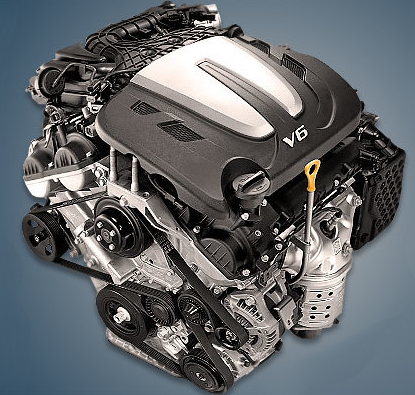
Lambda 3.0L family: G6DE, G6DG, and G6DL.
The engine was mounted on:
- Hyundai Grandeur 5 (HG) in 2012 – 2017; Grandeur 6 (IG) since 2017.
Specifications
| Production years | since 2012 |
| Displacement, cc | 2999 |
| Fuel system | distributed injection |
| Power output, hp | 250 |
| Torque output, Nm | 284 |
| Cylinder block | aluminum V6 |
| Block head | aluminum 24v |
| Cylinder bore, mm | 92 |
| Piston stroke, mm | 75.2 |
| Compression ratio | 10.6 |
| Features | DOHC |
| Hydraulic lifters | no |
| Timing drive | chain |
| Phase regulator | Dual CVVT |
| Turbocharging | no |
| Recommended engine oil | 5W-30 |
| Engine oil capacity, liter | 5.2 (there are versions with a pallet of 5.7 liters) |
| Fuel type | petrol |
| Euro standards | EURO 4/5 |
| Fuel consumption, L/100 km (for Hyundai Grandeur 2015) — city — highway — combined |
14.0 7.1 9.6 |
| Engine lifespan, km | ~350 000 |
| Weight, kg | 207 (with attachments) |
Disadvantages of the Hyundai G6DE engine
The motor’s increasing lubricant consumption is its most well-known issue.
Oil scraper rings are the primary cause, and decarbonization is ineffective.
The aluminum unit fears overheating, so keep the cooling system clean.
The timing chain, and particularly the hydraulic tensioner, caused a lot of problems in the early years.
An expensive valve adjustment procedure is needed approximately every 100,000 kilometers.