
Only a few well-known models, including the Elantra and Cerato Forte, were equipped with the 1.8-liter Hyundai G4NB engine, which was manufactured at the Ulsan facility between 2010 and 2016. The motor’s manufacturing was moved to China in 2013, where it is installed on the regional Mistra model.
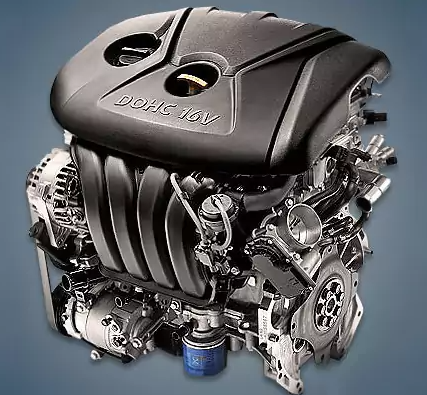
Hyundai-Kia debuted a new range of gasoline engines with the Nu index in 2010. These engines were 1.8 and 2.0 liters in size, with the only difference being the piston stroke. With an aluminum cylinder block, an aluminum 16-valve cylinder head with hydraulic compensators, a timing chain drive, MPi distributed fuel injection, and CVVT phase shifters on two camshafts, this motor is by design a classic for that era. Additionally, a plastic intake manifold with a VIS geometry change system was added to the unit.
The aluminum block of the engine with an open cooling jacket and thin cast-iron liners lacked high rigidity, which ultimately resulted in an ellipse of cylinders and an oil burner. This was one of the engine’s most serious design flaws. Additionally, if the catalytic converter is positioned too close to the engine block, crumbs from the collapsing catalyst may enter the combustion chambers and cause scoring to appear in the cylinders.
The engines in the Nu family are G4NB, G4NA, G4NC, G4ND, G4NE, G4NH, G4NG, G4NL, and G4NN.
The engine was mounted on:
- Hyundai Elantra 5 (MD) in 2010 – 2016;
- Hyundai i30 2 (GD) in 2011 – 2016;
- Kia Cerato 3 (YD) in 2012 – 2016.
Specifications
| Production years | 2010-2016 |
| Displacement, cc | 1797 |
| Fuel system | distributed injection |
| Power output, hp | 150 |
| Torque output, Nm | 178 |
| Cylinder block | aluminum R4 |
| Block head | aluminum 16v |
| Cylinder bore, mm | 81 |
| Piston stroke, mm | 87.2 |
| Compression ratio | 10.3 |
| Features | VIS |
| Hydraulic lifters | yes |
| Timing drive | chain |
| Phase regulator | CVVT |
| Turbocharging | no |
| Recommended engine oil | 5W-20, 5W-30 |
| Engine oil capacity, liter | 4.5 |
| Fuel type | petrol |
| Euro standards | EURO 4/5 |
| Fuel consumption, L/100 km (for Hyundai Elantra 2012) — city — highway — combined |
9.4 5.7 7.1 |
| Engine lifespan, km | ~300 000 |
| Weight, kg | 112 |
Disadvantages of the Hyundai G4NB engine
Above all, the engines in this family are chastised for the cylinders’ frequent scuffing. The catalytic converter was positioned too close to the engine block for a speedy warm-up, and when the catalyst crumbs clog it, they start to be drawn into the combustion chambers.
Because an aluminum block with thin-walled cast-iron liners can simply lead, a strong ellipse of cylinders and an oil burner accompanying this process will appear, the appearance of a large oil consumption does not always indicate seizures in the cylinders.
Here, a thin plate chain with a 120,000 km resource powers the timing drive; however, if the engine is not used frequently, you can drive roughly twice as much without replacing it. A stretched chain frequently bends the valves and jumps one tooth instead of breaking.
Additionally, owners frequently complain about oil or antifreeze leaks because the water pump, generator, and other attachments have very limited resources and weak gaskets.