
Since the 1.8-liter Hyundai G4JN engine was structurally identical to the Mitsubishi power unit with the 4G67 index, it was assembled under license in South Korea between 1998 and 2005. Local versions of the Sonata and Magentis had this Sirius II series DOHC motor installed for a while.
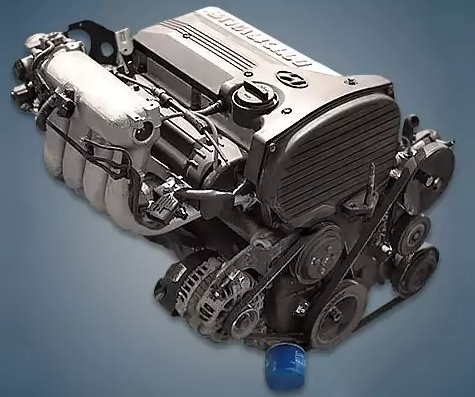
Sirius family: 1.6 L G4CR; 1.8 L G4CN, G4CM, G4JN; 2.0 L G4CP, G4JP; 2.4 L G4JS, G4CS.
The engine was mounted on:
- Hyundai Sonata 4 (EF) in 1998 – 2004;
- Kia Magentis 1 (GD) in 2000 – 2005.
Specifications
| Production years | 1998-2005 |
| Displacement, cc | 1836 |
| Fuel system | injector |
| Power output, hp | 125 – 135 |
| Torque output, Nm | 170 – 180 |
| Cylinder block | cast iron R4 |
| Block head | aluminum 16v |
| Cylinder bore, mm | 81.5 |
| Piston stroke, mm | 88 |
| Compression ratio | 10.5 |
| Features | no |
| Hydraulic lifters | yes |
| Timing drive | belt |
| Phase regulator | no |
| Turbocharging | no |
| Recommended engine oil | 10W-40 |
| Engine oil capacity, liter | 3.7 |
| Fuel type | petrol |
| Euro standards | EURO 2/3 |
| Fuel consumption, L/100 km (for Kia Magentis 2001) — city — highway — combined |
9.9 7.6 8.5 |
| Engine lifespan, km | ~300 000 |
| Weight, kg | 148.2 (without attachments) |
Disadvantages of the Hyundai G4JN engine
Timing and balancers are the two types of belts that you need to keep a close eye on. If any of them break, you will have to wait for a costly and complicated overhaul.
fail very quickly, and hydraulic lifters start making loud clicks;
Severe engine mount wear is typically the cause of the power unit’s vibrations;
Most frequently, contamination of the injectors, throttle, or idle speed controller causes the engine speed to float.