
From 1990 until 2014, the company produced the 0.7-liter, three-cylinder Mitsubishi 3G83 engine, which was fitted on well-known kei vehicles like the eK Sport, eK Wagon, Minica, Minicab, and Toppo. A unique cylinder head with five valves per cylinder set the supercharged version of this unit apart.
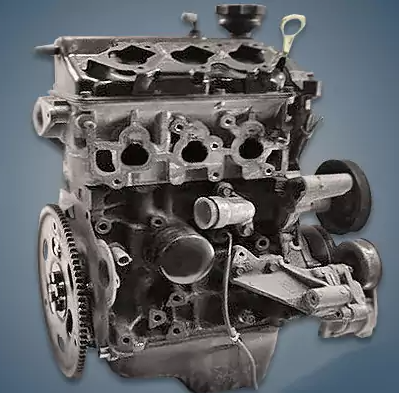
3G8 family: 3G81, 3G83.
Specifications
| Production years | 1990-2014 |
| Displacement, cc | 657 |
| Fuel system | carburetor (3G83K) distributed injection (3G83) distributed injection (3G83T) |
| Power output, hp | 39 (3G83K) 51 (3G83) 64 (3G83T) |
| Torque output, Nm | 51 (3G83K) 56 – 62 (3G83) 96 (3G83T) |
| Cylinder block | cast iron R3 |
| Block head | aluminum 6v (3G83K) aluminum 12v (3G83) aluminum 15v (3G83T) |
| Cylinder bore, mm | 65 |
| Piston stroke, mm | 66 |
| Compression ratio | 9.8 (3G83K) 9.8 – 10.2 (3G83) 8.5 (3G83T) |
| Features | SOHC (3G83K) DOHC (3G83) DOHC (3G83T) |
| Timing drive | belt |
| Phase regulator | no |
| Turbocharging | no (3G83K) no (3G83) MHI TD02MR2 (3G83T) |
| Recommended engine oil | 5W-20 |
| Engine oil capacity, liter | 3.2-3.3 |
| Fuel type | petrol |
| Euro standards | EURO 1 (3G83K) EURO 3/4 (3G83) EURO 3/4 (3G83T) |
| Fuel consumption, L/100 km (for Mitsubishi eK Sport 2005) — city — highway — combined |
6.1 4.2 5.2 |
| Engine lifespan, km | ~180 000 |
| Weight, kg | 88 (without attachments) |
The engine was installed on:
- Mitsubishi Bravo 1 (U14), Bravo 2 (U42), eK Active 1 (H81), eK Classy 1 (H81), eK Sport 1 (H81), eK Sport 2 (H82), eK Wagon 1 (H81), eK Wagon 2 (H82), Minica 6 (H21), Minica 7 (H32), Minica 8 (H42), Minicab 4 (U11), Minicab 5 (U41), Minicab 6 (U61), Minica Toppo 1 (H22), Minica Toppo 2 (H31), Toppo BJ 1 (H41), Toppo 1 (H82), Town Box 1 (U61);
- Nissan Clipper 1 (U71), NV100 1 (U72), Otti 1 (H91), Otti 2 (H92).
Disadvantages of the Mitsubishi 3G83 engine
The most well-known issue with this motor is the oil burner because of rings;
Even with a short drive and low oil level, the crankshaft liners rotate;
Maintain a clean cooling system to prevent the gasket from overheating;
Because the timing belt bends the valves when it breaks, check its condition more frequently;
Additionally, the engine’s fuel system and catalyst cannot withstand subpar gasoline.