
The company has only been producing the 2.2-liter Mitsubishi 4N14 diesel engine since 2010. It is found in the Delica D:5 minibus and the well-liked Outlander and ASX crossovers. The presence of a proprietary phase control system, like MIVEC, is emphasized by this aluminum unit.
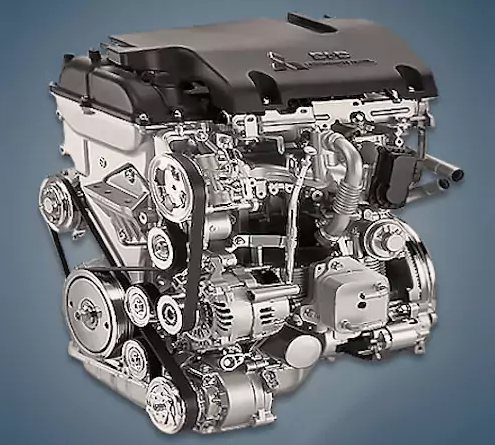
The 4N13 and 4N15 engines are also part of the 4N1 family.
The engine was mounted on:
- Mitsubishi ASX since 2013;
- Mitsubishi Delica D:5 since 2013;
- Mitsubishi Outlander 2 in 2010 – 2012;
- Mitsubishi Outlander 3 since 2012.
Specifications
| Production years | since 2010 |
| Displacement, cc | 2268 |
| Fuel system | Common Rail |
| Power output, hp | 150 – 177 |
| Torque output, Nm | 360 – 380 |
| Cylinder block | aluminum R4 |
| Block head | aluminum 16v |
| Cylinder bore, mm | 86 |
| Piston stroke, mm | 97.6 |
| Compression ratio | 14.9 |
| Features | intercooler |
| Hydraulic lifters | no |
| Timing drive | chain |
| Phase regulator | MIVEC |
| Turbocharging | VGT |
| Recommended engine oil | 5W-30 |
| Engine oil capacity, liter | 7.5 |
| Fuel type | diesel |
| Euro standards | EURO 5/6 |
| Fuel consumption, L/100 km (for Mitsubishi Outlander 2014) — city — highway — combined |
8.3 5.8 6.7 |
| Engine lifespan, km | ~350 000 |
| Weight, kg | 160 |
Disadvantages of the Mitsubishi 4N14 engine
This diesel engine has only demonstrated positive aspects thus far, possibly with the exception of a loud rattling;
A specific quantity of diesel fuel enters the oil while the particulate filter is burning;
Piezo injectors can malfunction even before 100,000 kilometers and dislike poor fuel;
The intake flaps continue to become stuck due to soot, and the EGR valve clogs rather quickly;
The injectors must be removed in order to adjust the thermal clearances of the valves once every 45,000 kilometers.