
From 1981 until 1998, the company produced the 1.7-liter Nissan CD17 diesel engine, which was fitted on several well-known models at the time, including the Sunny, Sentra, Pulsar, and AD. The Stanza liftback was equipped with a 75 horsepower, 145 Nm turbocharged CD17T power unit.
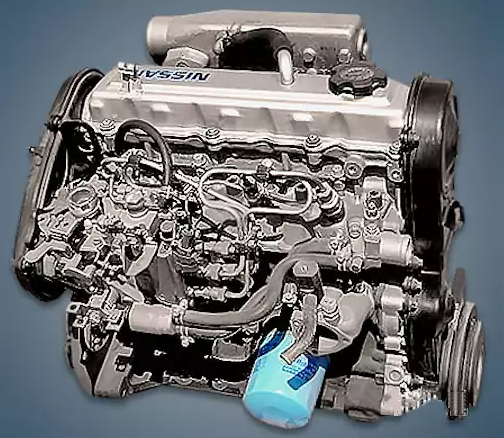
The CD20 and CD20T internal combustion engines are also part of the CD series.
The engine was mounted on:
- Nissan Sunny 1 (B11) in 1981 – 1985; Sunny 2 (B12) in 1985 – 1990; Sunny 3 (B13) in 1990 – 1993;
- Nissan Pulsar N12 in 1982 – 1986; Pulsar N13 in 1986 – 1990; Pulsar N14 in 1990 – 1995;
- Nissan Sentra 1 (B11) in 1982- 1986; Sentra 2 (B12) in 1985- 1990;
- Nissan AD VB11 in 1982 – 1990; AD 2 (Y10) in 1990 – 1998.
Specifications
| Production years | 1981-1998 |
| Displacement, cc | 1680 |
| Fuel system | vortex chamber |
| Power output, hp | 55 – 60 |
| Torque output, Nm | 104 |
| Cylinder block | cast iron R4 |
| Block head | aluminum 8v |
| Cylinder bore, mm | 80 |
| Piston stroke, mm | 83.6 |
| Compression ratio | 21.8 – 22.2 |
| Features | no |
| Hydraulic lifters | no |
| Timing drive | belt |
| Phase regulator | no |
| Turbocharging | no |
| Recommended engine oil | 10W-30 |
| Engine oil capacity, liter | 5.4 |
| Fuel type | diesel |
| Euro standards | EURO 1/2 |
| Fuel consumption, L/100 km (for Nissan Sunny 1989) — city — highway — combined |
7.6 5.1 5.9 |
| Engine lifespan, km | ~250 000 |
| Weight, kg | 170 |
Disadvantages of the CD17 engine
Injectors and a high-pressure fuel pump are the first places where issues arise because the motor cannot handle poor fuel;
The cooling system’s airing is the most frequent malfunction;
Fearing overheating, the engine cracks the block’s head and breaks the gasket;
Keep an eye on the timing belt’s condition because the valve will undoubtedly bend if it breaks;
After 250,000 kilometers, the cylinders’ compression typically decreases, necessitating an overhaul.