
Between 2005 and 2010, GM factories produced the 3.2-liter V6 Alfa Romeo 939A000 engine, which was fitted to popular Italian models like the Brera and the related Spider. Although it has its own cylinder heads and Twin Phaser phase regulators, the motor is based on the GM LU1 block.
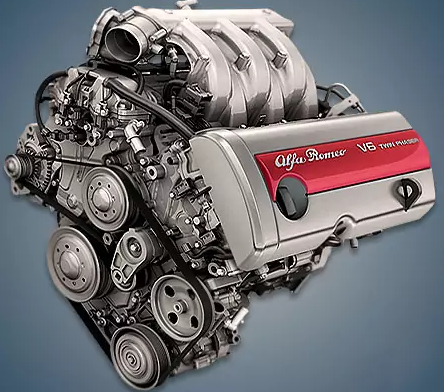
The JTS-engine series: 937A1000, 939A5000, 939A000.
Specifications
| Production years | 2005-2010 |
| Displacement, cc | 3195 |
| Fuel system | direct injection |
| Power output, hp | 260 |
| Torque output, Nm | 322 |
| Cylinder block | aluminum V6 |
| Block head | aluminum 24v |
| Cylinder bore, mm | 89 |
| Piston stroke, mm | 85.6 |
| Compression ratio | 11.25 |
| Features | DOHC |
| Hydraulic lifters | yes |
| Timing drive | chain |
| Phase regulator | Twin Phaser |
| Turbocharging | no |
| Recommended engine oil | 5W-40 |
| Engine oil capacity, liter | 5.4 |
| Fuel type | petrol |
| Euro standards | EURO 4 |
| Fuel consumption, L/100 km (for Alfa Romeo Brera 2008) — city — highway — combined |
18.5 8.7 12.5 |
| Engine lifespan, km | ~300 000 |
| Weight, kg | 195 |
The engine was installed on:
- Alfa Romeo 159 (Type 939) in 2005 – 2010;
- Alfa Romeo Brera I (Type 939) in 2005 – 2010;
- Alfa Romeo Spider VI (Type 939) in 2006 – 2010.
Disadvantages of the Alfa Romeo 939A000 engine
The timing chain’s lack of durability is the engine’s most well-known issue.
The oil change interval has a significant impact on the resource, and occasionally chains are changed every 50,000 kilometers.
This unit has carbon deposits on the intake valves, just like all direct injection units.
Because overheating quickly ruptures the cylinder head gaskets, keep the radiators clean.
Additionally, engines from the early years of production suffered from the catalyst’s quick breakdown.