
Produced between 2000 and 2010, the 1.6-liter Alfa Romeo AR32104, also known as the 156 1.6 TS engine, was fitted to the two most well-liked concern models at the time, designated 147 and 156. Unlike the larger engines of the series, this engine lacked a VLIM intake geometry change system.
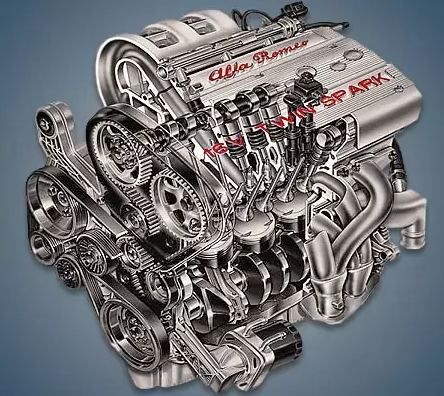
The Twin Spark line includes: AR32104, AR32201, AR32301, AR32310.
Specifications
| Production years | 2000-2010 |
| Displacement, cc | 1598 |
| Fuel system | distributed injection |
| Power output, hp | 120 |
| Torque output, Nm | 146 |
| Cylinder block | cast iron R4 |
| Block head | aluminum 16v |
| Cylinder bore, mm | 82 |
| Piston stroke, mm | 75.65 |
| Compression ratio | 10.3 |
| Features | DOHC |
| Hydraulic lifters | yes |
| Timing drive | belt |
| Phase regulator | VVT at the intake |
| Turbocharging | no |
| Recommended engine oil | 10W-40 |
| Engine oil capacity, liter | 4.4 |
| Fuel type | petrol |
| Euro standards | EURO 3 |
| Fuel consumption, L/100 km (for Alfa Romeo 156 2003) — city — highway — combined |
11.4 6.4 8.2 |
| Engine lifespan, km | ~250 000 |
| Weight, kg | 150 |
The engine was installed on:
- Alfa Romeo 147 (Type 937) in 2000 – 2010;
- Alfa Romeo 156 (Type 932) in 2000 – 2005.
Disadvantages of the Alfa Romeo AR32104 engine
Here, the oil pump fails quickly due to improper oil selection;
The resource of hydraulic lifters is diminished when the oil pump’s performance declines;
The camshaft cams then deteriorate as a result of the hydraulic lifters wedging;
A phase regulator, an electronic throttle, and a crankcase ventilation valve are the weak points in a strong oil burner that is frequently discovered on long runs as a result of stuck rings.