
Produced between 1998 and 2001, the 2.0 liter Alfa Romeo AR32301 or 156 2.0 TS engine was installed in a number of well-known models, including the 145, 146, 156, GTV, and Spider. Following an upgrade to meet Euro 3 environmental standards, this power unit became the AR32310 motor.
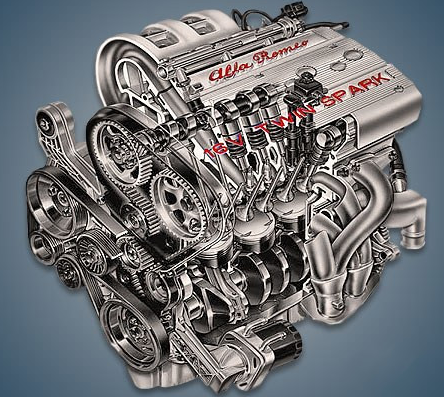
The Twin Spark line includes: AR32104, AR32201, AR32301, AR32310.
Specifications
| Production years | 1998-2001 |
| Displacement, cc | 1970 |
| Fuel system | distributed injection |
| Power output, hp | 155 |
| Torque output, Nm | 187 |
| Cylinder block | cast iron R4 |
| Block head | aluminum 16v |
| Cylinder bore, mm | 83 |
| Piston stroke, mm | 91 |
| Compression ratio | 10.0 |
| Features | DOHC, VLIM |
| Hydraulic lifters | yes |
| Timing drive | belt |
| Phase regulator | VVT at the intake |
| Turbocharging | no |
| Recommended engine oil | 10W-40 |
| Engine oil capacity, liter | 4.4 |
| Fuel type | petrol |
| Euro standards | EURO 2 |
| Fuel consumption, L/100 km (for Alfa Romeo 156 1999) — city — highway — combined |
11.7 6.7 8.5 |
| Engine lifespan, km | ~210 000 |
| Weight, kg | 170 |
The engine was installed on:
- Alfa Romeo 145 (Type 930) in 1998 – 2001;
- Alfa Romeo 146 (Type 930) in 1998 – 2001;
- Alfa Romeo 156 (Type 932) in 1997 – 2000;
- Alfa Romeo GTV II (Type 916) in 1998 – 2000;
- Alfa Romeo Spider V (Type 916) in 1998 – 2000.
Disadvantages of the Alfa Romeo AR32301 engine
The wear of the cylinder walls and the ensuing oil burn are the engine’s primary issues;
The engine’s sensors frequently malfunction, particularly the mass air flow sensor and crankshaft position; the balancer belt is short-lived and may fall under the timing belt if it breaks; the phase regulator, oil pump, and VLIM system in the intake are the weak points here; camshaft cams are also erased due to wedging of hydraulic lifters.