
From 2002 to 2006, the company assembled the 4.2-liter Audi BFM or A8 D3 4.2 quattro engine and installed it exclusively on all-wheel drive versions of the renowned A8 sedan in the D3 body. This power unit was available in a version with a 3.7-liter capacity and a unique BFL index.
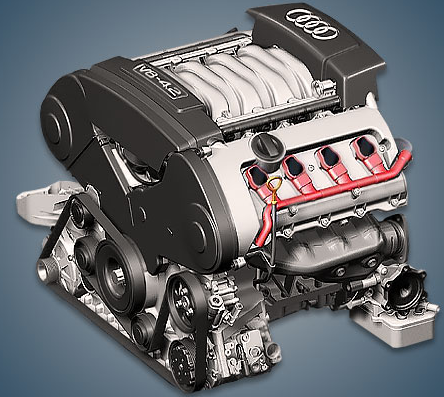
The EA824 series includes: AEW, ABZ, BFL, BFM, AXQ, BVJ, CDRA, BAR, CRDB, CEUA.
Specifications
| Production years | 2002-2006 |
| Displacement, cc | 4172 |
| Fuel system | distributed injection |
| Power output, hp | 335 |
| Torque output, Nm | 430 |
| Cylinder block | aluminum V8 |
| Block head | aluminum 40v |
| Cylinder bore, mm | 84.5 |
| Piston stroke, mm | 93 |
| Compression ratio | 11.0 |
| Features | no |
| Hydraulic lifters | yes |
| Timing drive | belt & 2 chains |
| Phase regulator | yes |
| Turbocharging | no |
| Recommended engine oil | 5W-30 |
| Engine oil capacity, liter | 7.5 |
| Fuel type | petrol |
| Euro standards | EURO 4 |
| Fuel consumption, L/100 km (for Audi A8 quattro 2004) — city — highway — combined |
17.5 8.7 11.9 |
| Engine lifespan, km | ~300 000 |
The engine was installed on:
- Audi A8 D3 (4E) in 2002 – 2006.
Disadvantages of the Audi BFM engine
Here, seizures in the cylinders are uncommon despite the aluminum block.
They won’t keep you waiting, though, thanks to frequent overheating and oil savings.
Unreliable hydraulic timing chain tensioners are the main cause of this issue.
Keep an eye on the timing belt’s condition; if it breaks, the valves will bend.
Oil leaks are also frequent, particularly where the engine and gearbox meet.