
The popular Explorer SUV’s second, third, and fourth generations were equipped with the 4.0-liter V6 Ford 99E or 4.0 SOHC engine, which was manufactured in Germany between 1997 and 2010. The fifth Mustang and Ranger pickup truck had a similar engine with a different index.
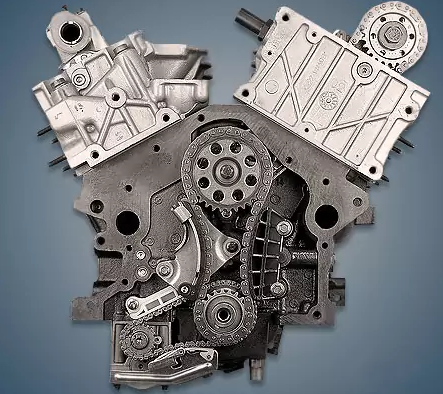
Cologne V6 family: BRF, 99E, 99X.
Specifications
| Production years | 1997 – 2010 |
| Displacement, cc | 3996 |
| Fuel system | distributed injection |
| Power output, hp | 210 – 215 |
| Torque output, Nm | 344 |
| Cylinder block | cast iron V6 |
| Block head | aluminum 12v |
| Cylinder bore, mm | 100.3 |
| Piston stroke, mm | 84.3 |
| Compression ratio | 9.7 |
| Features | SOHC |
| Hydraulic lifters | yes |
| Timing drive | chain |
| Phase regulator | no |
| Turbocharging | no |
| Recommended engine oil | 5W-30 |
| Engine oil capacity, liter | 4.7 |
| Fuel type | petrol |
| Euro standards | EURO 2/3 |
| Fuel consumption, L/100 km (for Ford Explorer 2007) — city — highway — combined |
15.7 11.2 13.1 |
| Engine lifespan, km | ~300 000 |
| Weight, kg | 214 |
The engine was installed on:
- Ford Explorer 2 (U105) in 1997 – 2003; Explorer 3 (U152) in 2000 – 2005; Explorer 4 (U251) in 2005 – 2010.
Disadvantages of the Ford 99E engine
The unreliable timing chain is this power unit’s most well-known issue.
Furthermore, the failure of the tensioners and guides is the only issue, not the chains themselves.
Severe valve guide wear is frequently observed at high mileage.
The hydraulic compensators will start to knock after 200,000 kilometers if you use inferior oils.
Short-lived gaskets and a lubricant pressure sensor are additional weak points.