
Only a redesigned version of the well-liked Haval H9 SUV is equipped with the 2.0-liter Great Wall GW4C20A gasoline engine, which has been manufactured in China since 2017. Under the GW4C20 symbol, such a power unit is basically a forced version of the engine.
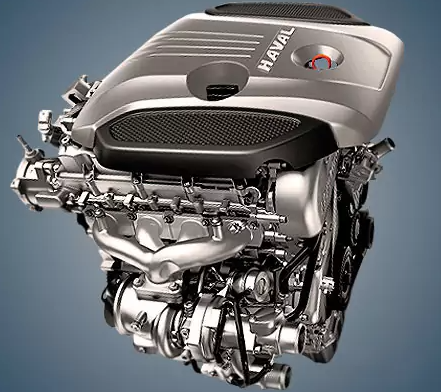
GW4C20, GW4C20A, GW4C20B, and GW4C20NT are your own 2.0-liter engines.
Specifications
| Production years | since 2017 |
| Displacement, cc | 1967 |
| Fuel system | direct injection |
| Power output, hp | 245 |
| Torque output, Nm | 350 |
| Cylinder block | cast iron R4 |
| Block head | aluminum 16v |
| Cylinder bore, mm | 82.5 |
| Piston stroke, mm | 92 |
| Compression ratio | 10.0 |
| Features | DOHC |
| Hydraulic lifters | yes |
| Timing drive | chain |
| Phase regulator | on all shafts |
| Turbocharging | BorgWarner K04 |
| Recommended engine oil | 5W-40 |
| Engine oil capacity, liter | 5.5 |
| Fuel type | petrol |
| Euro standards | EURO 5 |
| Fuel consumption, L/100 km (for Haval H9 2018) — city — highway — combined |
12.8 9.5 10.5 |
| Engine lifespan, km | ~220 000 |
| Weight, kg | 175 (with attachments) |
The engine was installed on:
- Haval H9 I in 2017 – 2021.
Disadvantages of the Great Wall GW4C20A engine
Although it hasn’t been manufactured in a while, this engine has performed admirably thus far.
Carbon deposits on the valves as a result of the direct injection system are the most problematic issue.
A bent impeller or a burst pipe can cause turbine failure in certain situations.
Complaints regarding the fuel pump and ignition system malfunctions can also be found on specialized forums.
The timing chain can already reach 120,000 km with rapid and frequent acceleration.