
The company has been producing the 2.0-liter Great Wall GW4D20T diesel engine since 2017. It is mounted on a redesigned version of the well-liked Haval H9 SUV. In essence, this power unit is a significantly improved GW4D20 diesel engine.
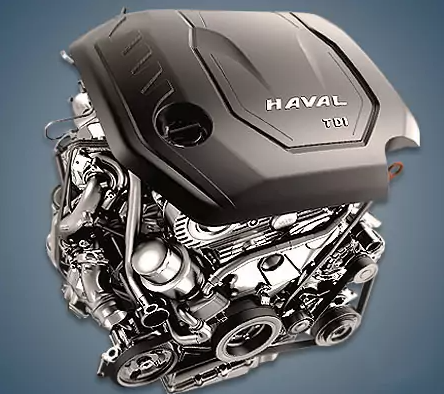
GW4D20, GW4D20B, GW4D20D, GW4D20T, and GW4D20M are your own diesel engines.
Specifications
| Production years | since 2017 |
| Displacement, cc | 1996 |
| Fuel system | Common Rail |
| Power output, hp | 190 |
| Torque output, Nm | 420 |
| Cylinder block | cast iron R4 |
| Block head | aluminum 16v |
| Cylinder bore, mm | 83.1 |
| Piston stroke, mm | 92 |
| Compression ratio | 16.0 |
| Features | DOHC |
| Hydraulic lifters | yes |
| Timing drive | belt |
| Phase regulator | no |
| Turbocharging | BorgWarner R2S |
| Recommended engine oil | 5W-30 |
| Engine oil capacity, liter | 5.5 |
| Fuel type | diesel |
| Euro standards | EURO 5 |
| Fuel consumption, L/100 km (for Haval H9 2020) — city — highway — combined |
10.5 7.0 8.4 |
| Engine lifespan, km | ~250 000 |
| Weight, kg | 210 (with attachments) |
The engine was installed on:
- Haval H9 I since 2017.
Disadvantages of the Great Wall GW4D20T engine
Currently, owners are rarely concerned about the engine because it has proven to be reliable; Delphi fuel equipment cannot handle poor fuel, so it is best to avoid saving on it;
This motor’s weak points in the service station are nozzles and a booster pump;
Contamination of the diesel particulate filter, EGR valve, and intake manifold has been reported.