
Produced in South Korea between 1992 and 2001, the 1.5-liter 16-valve BFD engine was fitted to the first two iterations of the well-known Sephia model and models similar to it. This device is a nearly identical replica of the popular Mazda B5-DE motor.
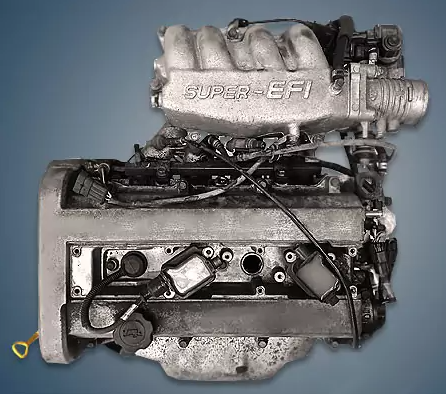
A3E, A5D, BFD, S5D, A6D, S6D, T8D, FED, and FEE are engines made by Kia.
Specifications
| Production years | 1992-2001 |
| Displacement, cc | 1498 |
| Fuel system | distributed injection |
| Power output, hp | 88 – 107 |
| Torque output, Nm | 135 – 147 |
| Cylinder block | cast iron R4 |
| Block head | aluminum 16v |
| Cylinder bore, mm | 78 |
| Piston stroke, mm | 78.4 |
| Compression ratio | 9.3 – 9.4 |
| Features | DOHC |
| Hydraulic lifters | yes |
| Timing drive | belt |
| Phase regulator | no |
| Turbocharging | no |
| Recommended engine oil | 5W-30 |
| Engine oil capacity, liter | 3.4 |
| Fuel type | petrol |
| Euro standards | EURO 2 |
| Fuel consumption, L/100 km (for Kia Sephia 1999) — city — highway — combined |
10.9 6.1 8.0 |
| Engine lifespan, km | ~240 000 |
| Weight, kg | 125.5 |
The engine was installed on:
- Kia Sephia 1 (FA) in 1992 – 1997; Sephia 2 (FB) in 1997 – 2001;
- Kia Shuma 1 (FB) in 1997 – 2001.
Disadvantages of the Kia BFD engine
This engine is entirely dependable, and the majority of its issues are caused by normal wear and tear;
The valves do not bend when the timing belt breaks because it only operates here for a brief period of time.
Due to ring and cap wear, oil consumption typically manifests after 200,000 kilometers;
Hydraulic lifters can already knock 100,000 kilometers and are not tolerant of low-quality lubricants;
The fuel pump, ignition system, and faulty wiring are the engine’s weak points.