
From 1989 to 2004, the company produced the 1.8-liter 16-valve Mazda BP engine, which was used in Kia vehicles under the T8D index as well as models like the Familia, Protege, Lantis, and MX-5. There was a version of the BP-VE with a phase shifter in addition to the standard and sports unit BP-ZE.
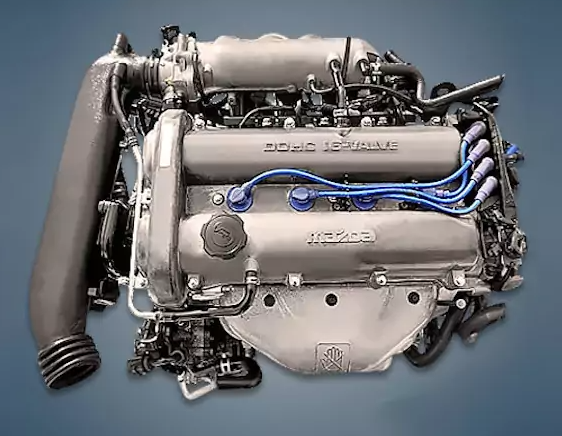
B1, B3, B3-ME, B5, B5-DE, B5-ME, B6, B6-ME, B6-DE, BP, and BP-ME are all members of the B-engine family.
The engine was mounted on:
- Mazda 323 BG in 1989 – 1994; 323 BH in 1994 – 1998;
- Mazda Eunos 100 BG in 1989 – 1994;
- Mazda Lantis CB in 1994 – 1998;
- Mazda Familia BG in 1989 – 1994; Familia BH in 1994 – 1998;
- Mazda MX-5 NA in 1994 – 1997; MX-5 NB in 1997 – 2001;
- Mazda Protege BG in 1989 – 1994; Protege BH in 1994 – 1998;
- (as T8D) Kia Carens 1 (FC) in 1999 – 2002; Carens 2 (FJ) in 2002 – 2006;
- (as T8D) Kia Clarus 1 (FE) in 1995 – 2001;
- (as T8D) Kia Spectra 1 (SD) in 2001 – 2004;
- (as T8D) Kia Sephia 1 (FA) in 1996 – 1999; Sephia 2 (FB) in 1997 – 2003;
- (as T8D) Kia Shuma 1 (FB) in 1997 – 2001; Shuma 2 (SD) in 2001 – 2004;
- Suzuki Baleno 1 (EG) in 1996 – 1998.
Specifications
| Production years | 1989-2004 |
| Displacement, cc | 1839 |
| Fuel system | injector |
| Power output, hp | 130 – 140 |
| Torque output, Nm | 150 – 160 |
| Cylinder block | cast iron R4 |
| Block head | aluminum 16v |
| Cylinder bore, mm | 83 |
| Piston stroke, mm | 85 |
| Compression ratio | 9.0 |
| Features | DOHC, VICS |
| Hydraulic lifters | yes |
| Timing drive | belt |
| Phase regulator | no |
| Turbocharging | no |
| Recommended engine oil | 5W-30 |
| Engine oil capacity, liter | 3.2 |
| Fuel type | petrol |
| Euro standards | EURO 2 |
| Fuel consumption, L/100 km (for Mazda Protege 1996) — city — highway — combined |
10.4 6.9 8.5 |
| Engine lifespan, km | ~330 000 |
| Weight, kg | 143.2 |
Disadvantages of the Mazda BP 1.8l engine
Although this power unit is well-known for its dependability, it frequently uses oil;
Here, lubrication consumption typically starts to show up before 100,000 kilometers and only increases with mileage;
Throttle contamination is the most common cause of floating engine speeds.
Regulations state that the timing belt must run 100,000 kilometers, but when it breaks, the valves never bend; hydraulic compensators frequently fail and cannot withstand poor-quality oil.