
From 1982 until 2005, the company’s Japanese plant assembled the 1.8-liter Mazda F8 engine in multiple versions simultaneously: with an injector and carburetor, as well as with 8, 12, and 16 valve cylinder heads. This motor is well-known from the 626 model found in the rear of the Bongo minibus or the GC-GD.
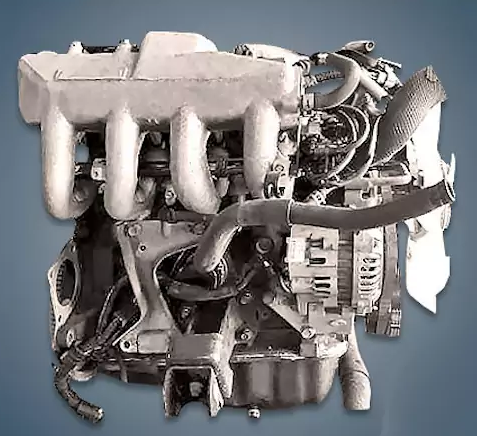
F6, FP, FP-DE, F8, FE, FE-DE, FE3N, FS, FS-DE, FS-ZE, and F2 are all members of the F-engine family.
The engine was mounted on:
- Mazda 626 GC in 1982 – 1987; 626 GD in 1987 – 1992;
- Mazda Bongo 3 in 1983 – 1999; Bongo 4 (SG) in 1999 – 2005;
- Mazda Capella GC in 1982 – 1987; Capella GD in 1987 – 1992; Capella GV in 1987 – 1997;
- Mazda MX-6 GD in 1987 – 1992;
- Mazda Eunos 300 MA in 1989 – 1992;
- Mazda Persona MA in 1988 – 1992;
- Kia Capital in 1989 – 1994;
- Kia Concord in 1987 – 1991.
Specifications
| Production years | 1982-2005 |
| Displacement, cc | 1789 |
| Fuel system | carburetor (F8 SOHC) injector (F8-E SOHC) injector (F8 DOHC) |
| Power output, hp | 80 – 95 (F8 SOHC) 90 – 100 (F8-E SOHC) 115 (F8 DOHC) |
| Torque output, Nm | 130 – 140 (F8 SOHC) 135 – 145 (F8-E SOHC) 157 (F8 DOHC) |
| Cylinder block | cast iron R4 |
| Block head | aluminum 8v / 12v (F8 SOHC) aluminum 12v (F8-E SOHC) aluminum 16v (F8 DOHC) |
| Cylinder bore, mm | 86 |
| Piston stroke, mm | 77 |
| Compression ratio | 8.6 (F8 SOHC) 9.1 – 9.4 (F8-E SOHC) 9.4 (F8 DOHC) |
| Features | SOHC (F8 SOHC) SOHC (F8-E SOHC) DOHC (F8 DOHC) |
| Hydraulic lifters | only on 12v cylinder head (F8 SOHC) yes (F8-E SOHC) yes (F8 DOHC) |
| Timing drive | belt |
| Phase regulator | no |
| Turbocharging | no |
| Recommended engine oil | 5W-30 |
| Engine oil capacity, liter | 3.9 |
| Fuel type | petrol |
| Euro standards | EURO 0 (F8 SOHC) EURO 1 (F8-E SOHC) EURO 1/2 (F8 DOHC) |
| Fuel consumption, L/100 km (for Mazda Bongo 2000) — city — highway — combined |
11.5 8.3 9.7 |
| Engine lifespan, km | ~275 000 |
| Weight, kg | 155.4 |
Disadvantages of the Mazda F8 1.8l engine
Сarburetor modifications that are not properly tuned use a lot of fuel;
Although injector-equipped models are more dependable, the ignition system is the primary source of issues;
Because of the presence of piston rings, an oil burner is frequently discovered on extended runs;
The valves do not bend here when the timing belt breaks, even though it travels an average of roughly 60,000 km;
Hydraulic lifters can travel up to 50,000 kilometers and are not tolerant of cheap oil.