
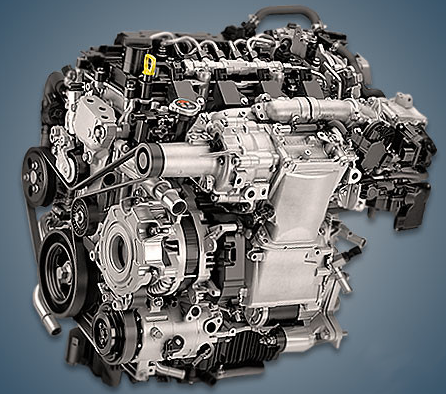
The fourth generation of the Mazda 3 model and the CX-30 crossover platform are equipped with the 2.0-liter Mazda HF-VPH or Skyactiv-X 2.0 engine, which has been manufactured in Japan since 2019. It stands out due to a fuel ignition system that is exclusive to gasoline units.
Specifications
| Production years | since 2019 |
| Displacement, cc | 1997 |
| Fuel system | direct injection |
| Power output, hp | 177 – 190 |
| Torque output, Nm | 224 – 240 |
| Cylinder block | aluminum R4 |
| Block head | aluminum 16v |
| Cylinder bore, mm | 83.5 |
| Piston stroke, mm | 91.2 |
| Compression ratio | 15.0 – 16.3 |
| Features | SPCCI |
| Hydraulic lifters | yes |
| Timing drive | chain |
| Phase regulator | Dual S-VT |
| Turbocharging | compressor |
| Recommended engine oil | 0W-20 |
| Engine oil capacity, liter | 4.6 |
| Fuel type | petrol |
| Euro standards | EURO 6 |
| Fuel consumption, L/100 km (for Mazda CX-30 2020) — city — highway — combined |
6.2 4.6 5.2 |
| Engine lifespan, km | ~250 000 |
| Weight, kg | 120 |
The engine was installed on:
- Mazda 3 IV (BP) since 2019;
- Mazda CX-30 I (DM) since 2019.
Disadvantages of the Mazda HF-VPH engine
They frequently only complain about poor traction at low revs on specialized forums.
The intake valves are covered in soot, just like in all direct injection engines.
The primary issue is that this is an uncommon unit, and replacement parts are costly and hard to come by.