
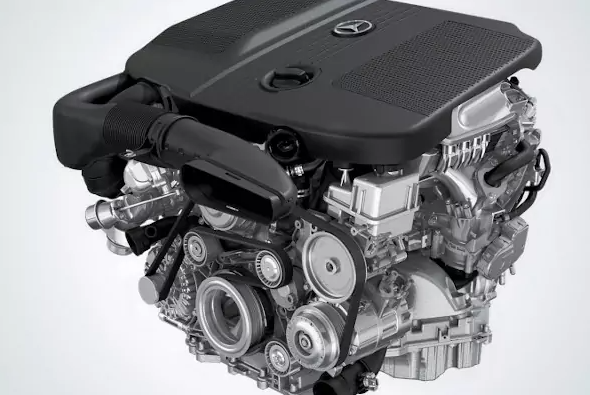
The Mercedes-Benz OM651 family of in-line four-cylinder diesel engines was first released in October 2008. It was designed to take the place of the OM646 and OM642 series. A plant in Stuttgart, Germany, was used for production.
OM616, OM601, OM604, OM611, OM640, OM646, OM651, OM654, and OM668 are the diesel R4-family.
A new generation of Mercedes’ 4-cylinder diesel vehicles was introduced in 2008. This includes an aluminum 16-valve cylinder head with hydraulic lifters, a cast-iron cylinder block, and a combined timing drive made up of a roller chain, multiple gears, and balancer shafts. The most potent versions of this engine have a BorgWarner R2S bi-turbo system, while simpler versions have an IHI VV20 or IHI VV21 variable geometry turbine.
Powerful versions of the diesel were originally fitted with a Delphi fuel system with piezo injectors, which caused a lot of problems. Since 2010, these injectors have been replaced with electromagnetic ones. Additionally, a campaign to replace injectors for previously manufactured units has been underway since 2011. Electromagnetic injectors and a Bosch fuel system are features of basic engine modifications.
DE18 LA (1796 cc) and DE22 LA (2143 cc) versions are offered. The power unit’s power varies between 107 and 204 horsepower, even though the majority of its variations have a working volume of 2143 cc. A twin turbo system is installed on versions over 125 kW (170 horsepower), while a single turbocharger is installed on versions under 100 kW.
Specifications
| Production years | since 2008 |
| Displacement, cc | 1796 (DE 18 LA red) 1796 (DE 18 LA) 2143 (DE 22 LA red) 2143 (DE 22 LA) |
| Fuel system | Common Rail |
| Power output, hp | 109 (DE 18 LA red) 136 (DE 18 LA) 95 – 143 (DE 22 LA red) 163 – 204 (DE 22 LA) |
| Torque output, Nm | 250 (DE 18 LA red) 300 (DE 18 LA) 250 – 360 (DE 22 LA red) 350 – 500 (DE 22 LA) |
| Cylinder block | cast iron R4 |
| Block head | aluminum 16v |
| Cylinder bore, mm | 83 |
| Piston stroke, mm | 83 (DE 18 LA red) 83 (DE 18 LA) 99 (DE 22 LA red) 99 (DE 22 LA) |
| Compression ratio | 16.2 |
| Hydraulic lifters | yes |
| Timing drive | chain & gears |
| Recommended engine oil | 5W-30 |
| Engine oil capacity, liter | 6.5 (11.5 in commercial models) |
| Fuel type | diesel |
| Euro standards | EURO 5/6 |
| Fuel consumption, L/100 km (for Mercedes E 250 CDI 2015) — city — highway — combined |
6.9 4.4 5.3 |
| Engine lifespan, km | ~400 000 |
| Weight, kg | 203.8 |
The engine was installed on:
- Mercedes A-Class W176 in 2012 – 2018;
- Mercedes B-Class W246 in 2011 – 2018;
- Mercedes C-Class W204 in 2008 – 2015; C-Class W205 in 2014 – 2018;
- Mercedes CLA-Class C117 in 2013 – 2018;
- Mercedes CLS-Class C218 in 2011 – 2018;
- Mercedes E-Class W212 in 2009 – 2016;
- Mercedes GLA-Class X156 in 2013 – 2019;
- Mercedes GLC-Class X253 in 2015 – 2019;
- Mercedes GLK-Class X204 in 2009 – 2015;
- Mercedes M-Class W166 in 2011 – 2018;
- Mercedes S-Class W221 in 2011 – 2013; S-Class W222 in 2014 – 2017;
- Mercedes SLK-Class R172 in 2012 – 2017;
- Mercedes Sprinter W906 in 2009 – 2018; Sprinter W907 since 2018;
- Mercedes V-Class W639 in 2010 – 2014; V-Class W447 in 2014 – 2019.
Features:
Because of the rear camshaft drive, the low, compact design helps to meet the legal requirements for pedestrian protection.
An injection pressure of up to 2000 bar is possible with the fourth generation common rail direct injection using piezo injectors, which Mercedes replaced with conventional ones as part of the service program because they proved to be problematic. High performance with minimal fuel consumption and exhaust emissions, as well as smooth engine operation and high flexibility in injection timing, are made possible by direct control of the injector needle.
Raw exhaust gas emissions, particularly nitrogen oxides, are decreased by the flat combustion chamber’s geometry and the reduced compression pressure. Up to 200 bar of maximum cycle pressure improves engine performance and helps lower harmful emissions.
A small high-pressure turbocharger and a large low-pressure turbocharger make up the compact two-stage boost module (not found on the GLK). Each one is made up of a compressor that is powered by a turbine that is connected in series. Both turbochargers are used to control the combustion air supply as needed. This guarantees improved cylinder filling, which raises torque even at low revs.
OM 651 engine block head
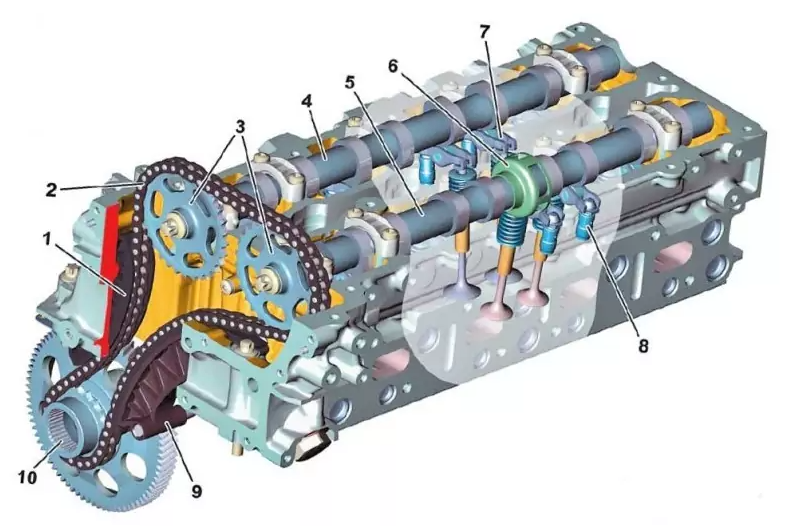
- Chain guide;
- Chain;
- Stars;
- Intake camshaft;
- Exhaust camshaft;
- Sensor;
- Roller rocker arm;
- Hydraulic compensator;
- Chain tensioner;
- Leading asterisk.
Disadvantages of the OM651 engine
Up until 2011, the primary models had a Delphi fuel system with piezo injectors, which were prone to leaks and frequently resulted in piston burnout and water hammer. A campaign to switch them out for more straightforward electromagnetic ones was even launched. There are no reliability issues with engine modifications that use a Bosch fuel system.
Cranking liners are a problem for many owners of vehicles with such diesel engines. This is brought on by either a drop in lubrication pressure from a malfunctioning variable displacement oil pump or dilution of superheated oil from a clogged heat exchanger. The pump control valve can be plugged in to operate at full capacity.
This combined timing drive is made up of multiple gears and a roller chain. Additionally, the chain has a 300,000 km service range, but its hydraulic tensioner is frequently rented much earlier, and replacing it is costly and time-consuming.
An oil cup that constantly leaks over the gasket, injectors adhering to the cylinder head, and cracks in the plastic intake manifold cause a lot of problems for this diesel engine. Additionally, the motor’s plastic pan and bi-turbo turbines are weak points.