
The 2.2-liter Opel Z22YH engine was built at a German facility between 2003 and 2010 and fitted to several of the company’s well-known models, including the Vectra, Zafira, and Signum. The same unit was installed on the Alfa Romeo as 2.2 JTS, but it was modified with phase regulators.
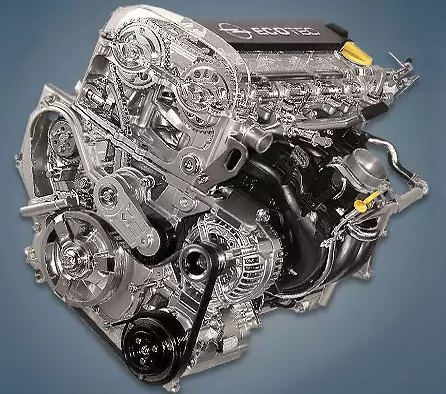
The engines Z20LET, Z22SE, Z24SED, Z28NET, and Z32SE are also members of the Z family.
Strong and capable of handling large loads is the Opel Z22YH engine. The Z22SE motor, which the company deemed outdated, was replaced by it. But unlike the Z22YH, the predecessor is still in use.
Based on the Z22SE, production of the Opel Z22YH 2.2 engine started. The engine has undergone some modifications in comparison to its predecessor, specifically:
- The crankshaft and pistons have been replaced,
- the compression ratio has been raised from 9.5 to 12,
- the direct injection cylinder head has been enhanced,
- and the timing chain has been employed.
Almost nothing else had changed. Every dimension and function is completely maintained.
The engine was mounted on:
- Opel Signum A (Z03) in 2003 – 2008;
- Opel Vectra C (Z02) in 2003 – 2008;
- Opel Zafira B (A05) in 2005 – 2010.
Specifications
| Manufacturer | Kaiserslautern plant |
| Displacement, cc | 2198 |
| Fuel system | direct injection |
| Power, hp | 150 – 155 |
| Torque output, Nm | 215 – 220 |
| Cylinder block | aluminum R4 |
| Cylinder head | aluminum 16v |
| Piston stroke, mm | 94.6 |
| Cylinder bore, mm | 86 |
| Compression ratio | 12.0 |
| Features | Twinport |
| Hydraulic lifters | yes |
| Timing drive | two chains |
| Phase regulator | no |
| Turbocharging | no |
| Euro standards | Euro 4 |
| Recommended engine oil | 5.0 liters 5W-30, 5W-40 |
| Fuel type | petrol |
| Fuel consumption, L/100 km (for Opel Vectra 2007) — city — highway — combined |
10.4 6.1 7.7 |
| Engine lifespan, km | 250 000 |
| Weight, kg | 140 |
Pros and cons of the engine
Opel Z22YH advantages
- dependable, strong motor that can handle large loads.
- Simple to fix.
- Fuel consumption is low enough for these indicators.
- Fuel economy is enhanced by direct injection.
Disadvantages of the Opel Z22YH
The timing chain will need to be changed multiple times more frequently if the oil is poorly chosen or of low quality.
The timing chain breaks more frequently in the initial models (since 2002) because of a mistake in the tensioner design.
You have to search for auto dismantlers because there are hardly any spare parts.
Since new ones are no longer made, overhauls can be very expensive.
If fuel and oil are not carefully chosen, repairs will be costly.
Frequent problems
Failure of the high-pressure fuel pump is caused by both low-quality fuel and refueling with gasoline that contains detergents. The engine does not produce more than 3000 rpm, the power decreases, and the Check Engine illuminates as clear indicators of a fuel pump failure. By measuring the fuel rail pressure, a breakdown can be accurately diagnosed. Direct gasoline injection offers superior fuel efficiency and throttle response, but it can also be extremely distressing due to sudden death.
balancer shaft and timing chain. The Z22YH motor’s chain breaks, with grave repercussions. However, the manufacturer advises replacing the chain every 150,000 kilometers, so the gap arises when the required interval is missed. If this isn’t done, all timing gears will start to wear down, and you won’t be able to wait until the chain breaks. Strong diesel can be heard even under the hood of a cold Z22YH engine due to a worn timing chain. As the engine warms up, diesel stops. If you purchase a new chain and the complete timing set, including the balance shaft, you can still save the motor.
The Z22YH motor’s air dampers are wedged in place. Increased fuel consumption and a sluggish acceleration response are warning signs. The instantaneous flow rate is between 0.5 and 0.9 l/h when the engine is warmed up and the climate is off (this range is determined by the existence of additional consumers that cannot be turned off manually).