
From 2009 to 2015, the 1.4-liter Peugeot EP3C, 8FP, or 8FR engine was assembled in Duvrin and fitted to several of the French company’s well-known compact models, including the 208 and 308. A gas version of this power unit was available under its own index, 8FN, in several markets.
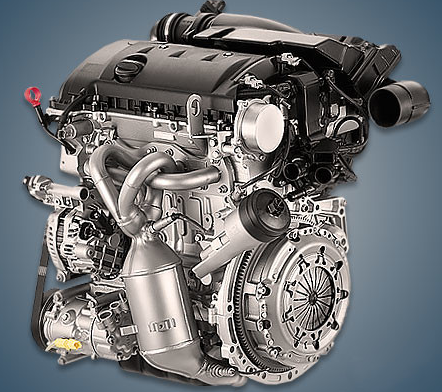
The Prince family of atmospheric engines includes the EP3, EP3C, EP6, EP6C, and EP6CB.
The Citroen C3 Picasso model debuted an upgraded version of the EP3 engine in 2009. This unit’s design was similar to that of its predecessor: an aluminum cylinder block, an aluminum 16-valve cylinder head with timing chain drive and hydraulic compensators, a Valvetronic throttleless control system, and a Vanos phase shifter on the intake and exhaust.
However, there were some differences: a new water pump with an electromagnetic clutch, a modernized vacuum pump, and a new oil pump with both pressure and flow control. The oil pressure sensor was moved from the cylinder head to the oil filter bracket, the crankshaft liners were given unique grooves to reduce friction and the need for lubrication, and a new catalyst was added, allowing the engine to meet Euro 5 environmental standards.
Specifications
| Production years | 2009-2015 |
| Displacement, cc | 1397 |
| Fuel system | injector |
| Power output, hp | 95 (8FP or VTI 95) 98 (8FR or VTI 98) |
| Torque output, Nm | 136 |
| Cylinder block | aluminum R4 |
| Block head | aluminum 16v |
| Cylinder bore, mm | 77 |
| Piston stroke, mm | 75 |
| Compression ratio | 11.0 |
| Hydraulic lifters | yes |
| Timing drive | chain |
| Phase regulator | yes |
| Turbocharging | no |
| Recommended engine oil | 5W-30, 5W-40 |
| Engine oil capacity, liter | 4.3 |
| Fuel type | petrol |
| Euro standards | EURO 5 |
| Fuel consumption, L/100 km (for Peugeot 208 2012) — city — highway — combined |
7.5 4.5 5.6 |
| Engine lifespan, km | ~200 000 |
| Weight, kg | 119 |
The engine was installed on:
- Citroen C3 II (A51) in 2009 – 2013;
- Citroen C3 Picasso II in 2009 – 2015;
- Citroen C4 II (B71) in 2011 – 2015;
- Citroen DS3 I (A55) in 2010 – 2013;
- Peugeot 207 I (A7) in 2009 – 2013;
- Peugeot 208 I (A9) in 2012 – 2015;
- Peugeot 308 I (T7) in 2010 – 2013.
Disadvantages of the Peugeot EP3C engine
Even though the updated engine’s timing resource has slightly increased and the chain is no longer stretched for 50,000 kilometers, runs of roughly 100,000 to 120,000 kilometers will probably still require attention. The abundance of reasonably priced replacement kits available is a good thing.
Modernization included a new oil pump with pressure control, which frequently wedges the motor. Your engine will quickly pick up the crankshaft liners and probably the camshafts if this occurs in low performance mode.
Regular Valvetronic system malfunctions are a major source of issues for owners. Special filters were added to Vanos phase regulator valves, but their resources remained unchanged.
A little less frequently than previously, but still frequently, there is an oil burner because of rings, valve seat damage and loss, and frequent lubricant and antifreeze leaks. Additionally, nodes like a pump, thermostat, or lambda probe are merely regarded as consumables.