
The first two generations of the Swift GTi and the comparable Cultus GTi were powered by the Suzuki G13B 1.3-liter gasoline engine, which was manufactured in Japan between 1986 and 1995. This DOHC unit and its SOHC counterpart G13BB, which was installed on the Jimny, are often confused.
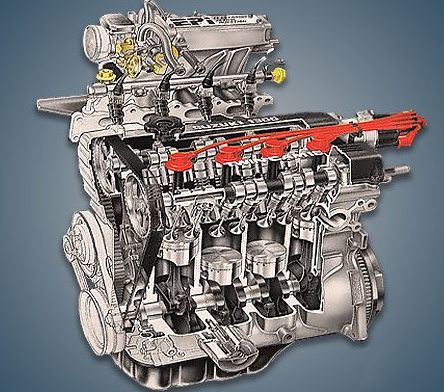
G-series engines include the G10A, G13B, G13BA, G13BB, G15A, G16A, and G16B.
Specifications
| Production years | 1986-1995 |
| Displacement, cc | 1298 |
| Fuel system | distributed injection |
| Power output, hp | 100 – 115 |
| Torque output, Nm | 109 – 112 |
| Cylinder block | aluminum R4 |
| Block head | aluminum 16v |
| Cylinder bore, mm | 74 |
| Piston stroke, mm | 75.5 |
| Compression ratio | 10 – 11.5 |
| Features | DOHC |
| Hydraulic lifters | no |
| Timing drive | belt |
| Phase regulator | no |
| Turbocharging | no |
| Recommended engine oil | 5W-30 |
| Engine oil capacity, liter | 3.2 |
| Fuel type | petrol |
| Euro standards | EURO 2 |
| Fuel consumption, L/100 km (for Suzuki Swift GTi 1987) — city — highway — combined |
7.8 5.5 6.3 |
| Engine lifespan, km | ~280 000 |
| Weight, kg | 82 (without attachments) |
The engine was installed on:
- Suzuki Cultus 1 (SA) in 1986 – 1988; Cultus 2 (SF) in 1988 – 1994;
- Suzuki Swift 1 (AA) in 1986 – 1989; Swift 2 (EA) in 1989 – 1995.
Disadvantages of the Suzuki G13B engine
The key is to prevent the motor from overheating so that it can run smoothly for a long time;
The aluminum block’s cooling jacket and occasionally the cylinder head are cracked by overheating;
Additionally, although it is quite possible to brew it, the exhaust manifold frequently bursts;
The unpredictability of an antiquated ignition system is the cause of many issues here;
The valve clearance needs to be changed every 30,000 kilometers, and it lacks hydraulic lifters.