
Produced since 2015, the 1.4-liter Suzuki K14C DITC or Boosterjet 1.4 turbo engine is found in popular Japanese models like the SX4, Vitara, and Swift in the Sport version. Currently, a hybrid modification with the symbol K14D is gradually replacing this power unit.
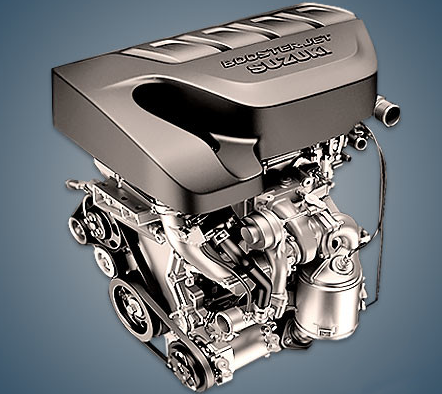
K-series engines include the K6A, K10A, K10B, K12B, K14C, K14B, and K15B.
Specifications
| Production years | since 2015 |
| Displacement, cc | 1373 |
| Fuel system | direct injection |
| Power output, hp | 135 – 140 |
| Torque output, Nm | 210 – 230 |
| Cylinder block | aluminum R4 |
| Block head | aluminum 16v |
| Cylinder bore, mm | 73 |
| Piston stroke, mm | 82 |
| Compression ratio | 9.9 |
| Features | DOHC |
| Hydraulic lifters | yes |
| Timing drive | chain |
| Phase regulator | at the intake |
| Turbocharging | MHI TD02L11-025 (there are versions with IHI turbine) |
| Recommended engine oil | 5W-30 |
| Engine oil capacity, liter | 3.3 |
| Fuel type | petrol |
| Euro standards | EURO 5/6 |
| Fuel consumption, L/100 km (for Suzuki Vitara 2018) — city — highway — combined |
6.2 4.7 5.2 |
| Engine lifespan, km | ~250 000 |
The engine was installed on:
- Suzuki SX4 2 (JY) since 2016;
- Suzuki Swift 5 (RZ) in 2018 – 2020;
- Suzuki Vitara 4 (LY) since 2015.
Disadvantages of the Suzuki K14C engine
This motor has been manufactured for over five years, and no unique issues have been reported to date;
Here, direct injection plays a role in the development of carbon deposits on the intake valves;
The turbine continues to operate normally, and instances of its sudden failure are still uncommon;
Concerns regarding timing chain stretching on runs of 100,000–150,000 km have been posted on specialized forums;
The aluminum engine cannot withstand overheating, so keep an eye on the cooling system’s condition.