
From 1994 until 2018, the company produced the 0.6-liter three-cylinder Suzuki K6A engine, which was found in nearly all of the company’s compact models, including the Alto, Wagon R, and Jimny. There was a very well-liked turbocharged version of the device in addition to the atmospheric version.
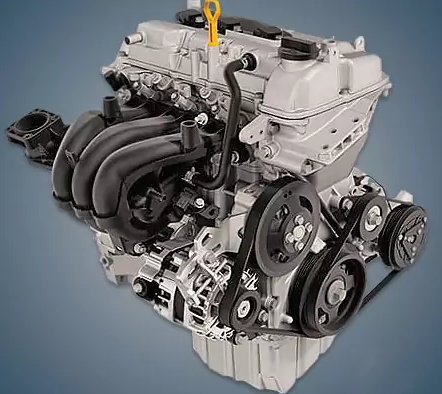
K-series engines include the K6A, K10A, K10B, K12B, K14C, K14B, and K15B.
One of the most well-liked engines for small Suzuki models made its debut in 1994. Distributed fuel injection, a three-cylinder aluminum block with cast-iron liners, an open cooling jacket, an aluminum 12-valve DOHC cylinder head without hydraulic compensators, and a timing chain are all examples of its innovative design for its time. The motor underwent numerous upgrades; for instance, it was the first in the K-series to get a phase regulator.
This power unit can be modified in a plethora of ways, including simple atmospheric, economical Lean Burn, hybrid, gas, and with an intercooler and an IHI or Hitachi turbine.
Specifications
| Production years | 1994-2018 |
| Displacement, cc | 658 |
| Fuel system | distributed injection |
| Power output, hp | 37 – 54 (atmospheric modifications) 60 – 64 (turbo modifications) |
| Torque output, Nm | 55 – 63 (atmospheric modifications) 83 – 108 (turbo modifications) |
| Cylinder block | aluminum R3 |
| Block head | aluminum 12v |
| Cylinder bore, mm | 68 |
| Piston stroke, mm | 60.4 |
| Compression ratio | 10.5 (atmospheric modifications) 8.4 – 8.9 (turbo modifications) |
| Hydraulic lifters | no |
| Timing drive | chain |
| Turbocharging | no (atmospheric modifications) yes (turbo modifications) |
| Recommended engine oil | 5W-30, 5W-40 |
| Engine oil capacity, liter | 2.9 |
| Fuel type | petrol |
| Euro standards | EURO 4/5 |
| Fuel consumption, L/100 km (for Suzuki Jimny 2000) — city — highway — combined |
7.9 5.2 6.1 |
| Engine lifespan, km | ~250 000 |
The engine was installed on:
- Suzuki Alto 4 (HA11) in 1994 – 1998; Alto 5 (HA12) in 1998 – 2004; Alto 6 (HA24) in 2004 – 2009; Alto 7 (HA25) in 2009 – 2014;
- Suzuki Cappuccino 1 (EA11) in 1995 – 1998;
- Suzuki Cervo 5 (HG21) in 2006 – 2009;
- Suzuki Every 4 (DA52) in 2001 – 2005; Every 5 (DA64) in 2005 – 2015;
- Suzuki Jimny 2 (SJ) in 1995 – 1998; Jimny 3 (FJ) in 1998 – 2018;
- Suzuki Lapin 1 (HE21) in 2002 – 2008; Lapin 2 (HE22) in 2008 – 2015;
- Suzuki MR Wagon 1 (MF21) in 2001 – 2006; MR Wagon 2 (MF22) in 2006 – 2011;
- Suzuki Kei 1 (HN11) in 1998 – 2009;
- Suzuki Palette 1 (MK21) in 2008 – 2013;
- Suzuki Wagon R 1 (CT21) in 1995 – 1998; Wagon R 2 (MC21) in 1998 – 2003; Wagon R 3 (MH21) in 2003 – 2008; Wagon R 4 (MH23) in 2008 – 2012;
- Mazda AZ-Wagon II (MD11) in 1998 – 2003; AZ-Wagon III (MJ21) in 2003 – 2008; AZ-Wagon IV (MJ23) in 2008 – 2012;
- Mazda Carol IV (HB12) in 1998 – 2003; Carol V (HB24) in 2004 – 2009; Carol VI (HB25) in 2009 – 2014;
- Mazda Laputa I (HP) in 1999 – 2006;
- Mazda Spiano I (HF) in 2002 – 2008;
- Nissan Moco 1 (G21) in 2002 – 2006; Moco 2 (G22) in 2006 – 2011;
- Nissan Pino 1 (HC24) in 2007 – 2010;
- Nissan Roox 1 (ML21) in 2009 – 2013.
Disadvantages of the Suzuki K6A engine
A lot of engine modifications have an IHI or slightly less Hitachi turbine, and they hardly ever travel more than 50,000 kilometers without considering the power unit. After a trip, you should let the engine idle and change the oil on a regular basis.
A cylinder head gasket failure is the second most common issue with this engine. Keep an eye on the state of the motorized fan, pump, and cooling system.
The timing chain is supposed to change every 90,000 kilometers, but it stretches even earlier for active drivers, particularly in the turbine version. Additionally, the valves bend when it jumps.
Oil scraper rings typically lie down and a small oil burner appears on runs longer than 150,000 kilometers. In most cases, decarbonizing won’t help, so the rings need to be replaced.
Grease leaks through the oil seals and the ribbed belt tensioner bearing wedges, and detonation occurs frequently when low-octane gasoline is used in hot weather. Here, valve burnout is a very frequent occurrence, so don’t forget to adjust the gaps.