
From 1990 until 2005, the company produced the 1.6-liter Suzuki G16B gasoline engine, which was fitted to well-known concern models like the Baleno, Swift, Vitara, and Grand Vitara. For some markets, this unit was essentially a 16-valve version of the G16A.
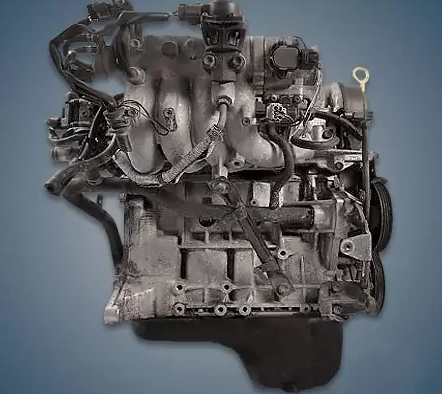
G-series engines include the G10A, G13B, G13BA, G13BB, G15A, G16A, and G16B.
A 16-valve variant of the G16A engine, known as the G16B in some nations, was introduced in 1990. The motor has a very basic design, consisting of an aluminum cylinder head with a single 16-valve camshaft, a timing belt drive, and an aluminum cylinder block with cast-iron liners. Although single injection and carburetors are also options, distributed fuel injection is the most common.
Depending on the vehicle, the motor may be positioned longitudinally, as in all the various modifications of the Vitara and Grand Vitara models, or transversely, as in the Swift or Baleno. The majority of models lack hydraulic lifters; instead, a screw is used to adjust the valves.
Specifications
| Production years | 1990-2005 |
| Displacement, cc | 1590 |
| Fuel system | distributed injection |
| Power output, hp | 90 – 100 |
| Torque output, Nm | 125 – 140 |
| Cylinder block | aluminum R4 |
| Block head | aluminum 16v |
| Cylinder bore, mm | 75 |
| Piston stroke, mm | 90 |
| Compression ratio | 9.5 |
| Hydraulic lifters | no |
| Timing drive | belt |
| Turbocharging | no |
| Recommended engine oil | 5W-30, 5W-40 |
| Engine oil capacity, liter | 4.2 |
| Fuel type | petrol |
| Euro standards | EURO 2/3 |
| Fuel consumption, L/100 km (for Suzuki Vitara 2000) — city — highway — combined |
10.0 6.8 8.0 |
| Engine lifespan, km | ~350 000 |
| Weight, kg | 89 (without attachments) |
The engine was installed on:
- Suzuki Baleno 1 (EG) in 1995 – 2002;
- Suzuki Grand Vitara 1 (FT) in 1998 – 2005;
- Suzuki Swift 2 (EA) in 1990 – 1995;
- Suzuki Vitara 1 (ET) in 1991 – 1998; Vitara 2 (FT) in 1998 – 2005.
Disadvantages of the Suzuki G16B engine
The development of cracks in the cooling jacket is the motor’s most significant issue. Attempting to weld an aluminum block that has an antifreeze leak makes no sense because it will burst again.
The development of cracks in the exhaust manifold is the second most frequent failure. Additionally, you can find an updated version made after 1994 or brew it yourself.
The antiquated ignition system causes a lot of issues and frequently floods the spark plugs here during extended attempts to start in the cold, just like in any engine from that era.
The manual states that the belt should be replaced once every 90,000 kilometers, but many people use inexpensive replacements because the original belt only lasts so long. Additionally, it is advantageous that the valves do not bend here when the belt breaks.
Lubrication leaks account for a large portion of the complaints on the specialized forums, and the oil typically climbs through the distributor’s pressure sensor or from underneath it.