
Models like the Escudo, X-90, Cultus, and Swift helped the 1.6-liter Suzuki G16A engine gain popularity after it was first introduced in 1988. For 8 and 16 valves, there are two variations; the older version is more commonly referred to as the G16B.
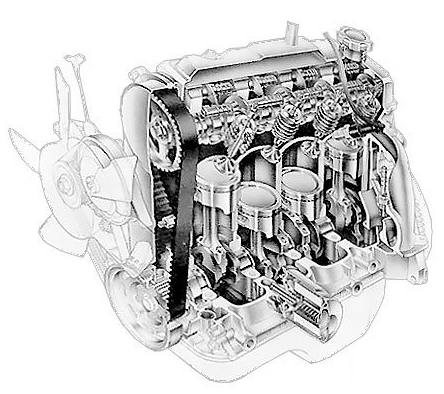
G-series engines include the G10A, G13B, G13BA, G13BB, G15A, G16A, and G16B.
A 1.6-liter engine joined the G-series family of small engines in 1988. A timing belt drive, an aluminum cylinder block with cast-iron liners, and an aluminum 8-valve cylinder head without hydraulic lifters (valve clearance is adjusted by a screw) are all part of the design. The engine came in single-injection, distributed-injection, and carburetor versions.
Specifications
| Production years | 1988-2002 |
| Displacement, cc | 1590 |
| Fuel system | carburetor / mono injection (8-valve ver.) distributed injection (16-valve ver.) |
| Power output, hp | 75 – 85 (8v ver.) 90 – 105 (16v ver.) |
| Torque output, Nm | 120 – 130 (8v ver.) 130 – 140 (16v ver.) |
| Cylinder block | aluminum R4 |
| Block head | aluminum 8v aluminum 16v |
| Cylinder bore, mm | 75 |
| Piston stroke, mm | 90 |
| Compression ratio | 8.9 (8v ver.) 9.5 (16v ver.) |
| Hydraulic lifters | no |
| Timing drive | belt |
| Turbocharging | no |
| Recommended engine oil | 5W-30, 5W-40 |
| Engine oil capacity, liter | 4.2 |
| Fuel type | petrol |
| Euro standards | EURO 1 (8v ver.) EURO 2 (16v ver.) |
| Fuel consumption, L/100 km (for Suzuki Escudo 1995) — city — highway — combined |
12.0 7.5 9.5 |
| Engine lifespan, km | ~300 000 |
| Weight, kg | 86 (without attachments) |
The engine was installed on:
- Suzuki Cultus 2 (SF) in 1992 – 1995; Cultus 3 (SY) in 1995 – 2002;
- Suzuki Escudo 1 (ET) in 1988 – 1998;
- Suzuki Swift 2 (EA) in 1991 – 1995;
- Suzuki X-90 1 (LB) in 1995 – 1998.
Disadvantages of the Suzuki G16A engine
Cracks in the cooling jacket are the most well-known issue with these units. Instead of attempting to weld an aluminum block if you run out of antifreeze, find another one.
The exhaust manifold can be welded, but it frequently cracks even here. It is better to use the stronger version of the manifold that was introduced in 1994.
It causes a lot of problems, just like any engine with an antiquated ignition system. However, the engine has a proprietary weakness where it floods candles all the time in the winter.
Although most owners use non-original belts with a shorter resource, the regulations state that the timing belt must be changed every 90,000 kilometers. The fact that the valves don’t bend is also beneficial.
Owners of vehicles with these engines frequently complain about leaks on specialized forums, particularly when grease seeps through the distributor’s pressure sensor or from beneath it.