
Since 1998, the 2.0-liter Suzuki J20A gasoline engine has been assembled by the Japanese company, and the Grand Vitara equipped with it is still offered for sale in a few developing nations. The motor comes in two different versions with different intake manifolds, camshafts, and cylinder heads.
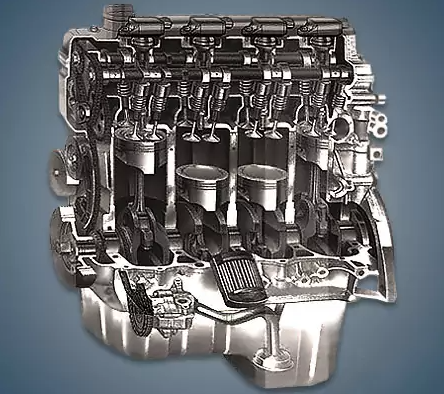
J-series engines include the J18A, J20A, J20B, J23A, and J24B.
A 2.0-liter engine with distributed fuel injection, which was fairly common at the time, debuted under the J20 index on the first generation of the Grand Vitara in 1998. Additionally, it features a timing chain drive, an aluminum 16-valve cylinder head without hydraulic lifters, cast-iron liners, an open cooling jacket, and an aluminum cylinder block. The motor lacks a variable valve timing system and has a very straightforward design.
The updated J20A engine debuted on the American version of the Liana, the Suzuki Aerio, in 2001. However, it gained popularity when it started to be fitted on the second generation Grand Vitara. Its power has increased from 128 to 145 horsepower as a result of the new cylinder head and higher compression ratio. Hydraulic valve clearance compensators were typically included in even American versions of the engine.
Specifications
| Production years | since 1998 |
| Displacement, cc | 1995 |
| Fuel system | distributed injection |
| Power output, hp | 128 – 145 |
| Torque output, Nm | 174 – 190 |
| Cylinder block | aluminum R4 |
| Block head | aluminum 16v |
| Cylinder bore, mm | 84 |
| Piston stroke, mm | 90 |
| Compression ratio | 9.3 – 10.5 |
| Hydraulic lifters | no |
| Timing drive | chain |
| Phase regulator | no |
| Turbocharging | no |
| Recommended engine oil | 5W-30, 5W-40 |
| Engine oil capacity, liter | 4.7 |
| Fuel type | petrol |
| Euro standards | EURO 4/5 |
| Fuel consumption, L/100 km (for Suzuki Grand Vitara 2007) — city — highway — combined |
11.6 7.6 9.1 |
| Engine lifespan, km | ~300 000 |
The engine was installed on:
- Suzuki Aerio 1 (ER) in 2001 – 2007;
- Suzuki SX4 1 (GY) in 2006 – 2010;
- Suzuki Escudo 2 (FT) in 1998 – 2005; Escudo 3 (JT) in 2005 – 2017;
- Suzuki Grand Vitara 1 (FT) in 1998 – 2005; Grand Vitara 2 (JT) since 2005.
Disadvantages of the Suzuki J20A engine
Owners of these engines typically complain about the oil burner on specialized forums. Hardened valve stem seals are typically the cause, but if changing them doesn’t work, it’s time to overhaul the motor and adjust the sleeves’ bore to the repair size.
Owners of older cars frequently save on fuel and lubricants, which frequently results in crankshaft liners turning and ultimately the wedge of your unit. This motor is very demanding on the quality of the oil and especially on the process of replacing it.
The timing drive in this engine is made up of three thin, low-resource chains that occasionally stretch and need to be replaced after 100–120 thousand kilometers. However, hydraulic chain tensioners may fail sooner because of oil savings.
It is terrified of overheating, which frequently results in the cylinder head, just like any aluminum engine. Additionally, the crankshaft oil seals are continuously flowing and the intake manifold becomes quickly clogged. Additionally, remember to check the valve clearances and candle condition every 30,000 kilometers.