
Popular concern models like the third Golf, fourth Passat, and Vento were equipped with the 1.6-liter Volkswagen AFT engine, which was assembled at the company’s plant between 1995 and 1999. One of the first members of the new family with an aluminum block was this unit.
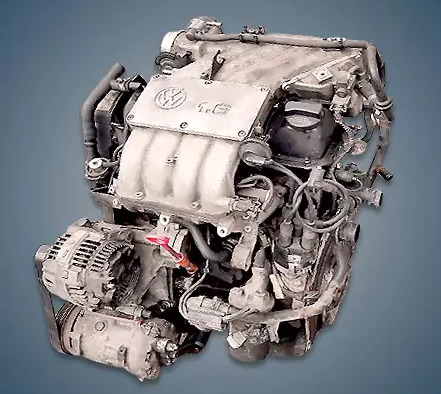
The PN, AFT, and ADP models are part of the EA827 1.6l series.
Specifications
| Production years | 1995-1999 |
| Displacement, cc | 1595 |
| Fuel system | injector |
| Power output, hp | 101 |
| Torque output, Nm | 140 |
| Cylinder block | aluminum R4 |
| Block head | aluminum 8v |
| Cylinder bore, mm | 81 |
| Piston stroke, mm | 77.4 |
| Compression ratio | 10.3 – 10.5 |
| Features | SOHC |
| Hydraulic lifters | yes |
| Timing drive | belt |
| Phase regulator | no |
| Turbocharging | no |
| Recommended engine oil | 5W-30 |
| Engine oil capacity, liter | 4.5 |
| Fuel type | petrol |
| Euro standards | EURO 3 |
| Fuel consumption, L/100 km (for VW Golf 3 1996) — city — highway — combined |
10.9 6.1 7.9 |
| Engine lifespan, km | ~300 000 |
The engine was installed on:
- Volkswagen Golf 3 (1H) in 1995 – 1999;
- Volkswagen Passat B4 (3A) in 1995 – 1996;
- Volkswagen Polo 3 (6N) in 1995 – 1999;
- Volkswagen Vento 1 (1H) in 1995 – 1998;
- Seat Cordoba 1 (6K) in 1995 – 1999;
- Seat Ibiza 2 (6K) in 1996 – 1999;
- Seat Toledo 1 (1L) in 1996 – 1999.
Disadvantages of the VW AFT engine
The engine’s vibrations and floating revolutions cause the owners’ biggest issues;
Flushing the throttle and nozzles is the first step in combating unstable engine operation.
Additionally, the tube of the crankcase exhaust valve frequently bursts and fails;
The antifreeze temperature sensor and thermostat don’t have the best resources;
Oil consumption starts on runs longer than 200,000 kilometers because of ring and cap wear.