
From 2000 to 2005, the company assembled the Volkswagen AWM 1.8T 1.8-liter turbo engine, which was fitted to American versions of well-known models like the Passat B5 and Audi A4. Only a longitudinal arrangement beneath the car’s hood was assumed by this power unit.
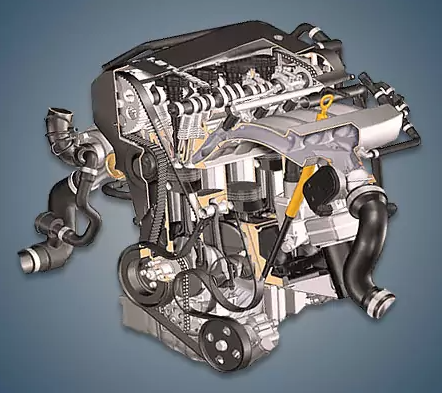
AGU, AWT, AMB, AWM, AUQ, and AWC are all part of the EA113-1.8T series.
Specifications
| Production years | 2000-2005 |
| Displacement, cc | 1781 |
| Fuel system | injector |
| Power output, hp | 170 |
| Torque output, Nm | 225 |
| Cylinder block | cast iron R4 |
| Block head | aluminum 20v |
| Cylinder bore, mm | 81 |
| Piston stroke, mm | 86.4 |
| Compression ratio | 9.3 |
| Features | DOHC |
| Hydraulic lifters | yes |
| Timing drive | chain & belt |
| Phase regulator | controlled tensioner |
| Turbocharging | KKK K03 |
| Recommended engine oil | 5W-30 |
| Engine oil capacity, liter | 3.7 |
| Fuel type | petrol |
| Euro standards | EURO 4 |
| Fuel consumption, L/100 km (for VW Passat B5 GP 2001) — city — highway — combined |
12.2 6.8 8.5 |
| Engine lifespan, km | ~310 000 |
The engine was installed on:
- Audi A4 B5 (8D) in 2000 – 2001;
- Volkswagen Passat B5 (3B) in 2000 – 2005.
Disadvantages of the VW AWM engine
Engine turbine failure is frequently caused by coking of oil in the oil supply pipe;
The primary cause of floating engine speeds is air leakage in the intake;
Here, ignition coils with integrated switches frequently malfunction;
Following critical wear of the controlled tensioner, the timing chain may jump;
The primary cause of carbon deposits is a malfunctioning crankcase ventilation system; electrically, the coolant temperature sensor or the mass air flow sensor is typically faulty;
Additionally, the secondary air system and the N75 valve are the motor’s weak points.