
From 2005 to 2014, a number of the company’s mass models, including the Golf, Passat, Touran, and Caddy, were equipped with the 1.6-liter VW BSE engine, which was manufactured in Germany or Hungary. Audi, Volkswagen, Seat, and Skoda vehicles all have BSE motors under the hood.
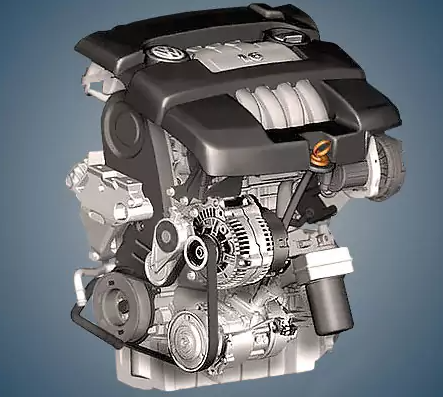
AEH, AHL, AKL, ALZ, ANA, APF, ARM, AVU, BFQ, BGU, BSE, and BSF are all part of the EA113-1.6 series.
A comparable engine with the BSE index took the place of the 1.6-liter BGU unit in 2005. This engine has an aluminum cylinder block, cast-iron liners, an aluminum 8-valve SOHC cylinder head with hydraulic lifters, and a timing belt drive. It is naturally aspirated. Here, an absolute pressure sensor, a mechanical thermostat, two lambda probes, and a plastic intake manifold with a geometry change system are used to distribute and regulate fuel injection.
In contrast to its predecessors, this engine retained the secondary air pump but did away with the heat exchanger and EGR valve. Euro 5 is supported by certain engine versions. Here, the throttle is electrically operated and a dual ignition coil is employed.
Specifications
| Production years | 2005-2014 |
| Displacement, cc | 1595 |
| Fuel system | injector |
| Power output, hp | 102 |
| Torque output, Nm | 148 |
| Cylinder block | aluminum R4 |
| Block head | aluminum 8v |
| Cylinder bore, mm | 81 |
| Piston stroke, mm | 77.4 |
| Compression ratio | 10.5 |
| Features | SOHC |
| Hydraulic lifters | yes |
| Timing drive | belt |
| Phase regulator | no |
| Turbocharging | no |
| Recommended engine oil | 5W-30 |
| Engine oil capacity, liter | 4.5 |
| Fuel type | petrol |
| Euro standards | EURO 4/5 |
| Fuel consumption, L/100 km (for VW Golf 2007) — city — highway — combined |
9.8 5.6 7.2 |
| Engine lifespan, km | ~400 000 |
The engine was installed on:
- Audi A3 2 (8P) in 2005 – 2013;
- Seat Altea 1 (5P) in 2005 – 2010;
- Seat Leon 2 (1P) in 2005 – 2010;
- Seat Toledo 3 (5P) in 2005 – 2009;
- Skoda Octavia 2 (1Z) in 2005 – 2013;
- Volkswagen Caddy 3 (2K) in 2005 – 2010;
- Volkswagen Jetta 5 (1K) in 2005 – 2010;
- Volkswagen Golf 5 (1K) in 2005 – 2009; Golf 6 (5K) in 2008 – 2013;
- Volkswagen Golf Plus 1 (5M) in 2005 – 2014;
- Volkswagen Passat B6 (3C) in 2005 – 2010;
- Volkswagen Touran 1 (1T) in 2005 – 2010.
Disadvantages of the VW BSE engine
The oil burner is the primary source of complaints from the owners of this reasonably dependable motor. Oil consumption occurs when valve stem seals or rings wear out after 150–200 thousand kilometers. Usually, decarbonizing is ineffective; the engine must be disassembled.
A banal crack in the ignition coil or oxidation of its high-voltage contacts, a clogged mesh in the fuel pump, air leaks through the intake or wedge of the drive system to alter its geometry, and other factors can all contribute to the engine’s unstable operation.
The timing belt should be changed every 120,000 kilometers, according to the manuals, but if it bursts sooner, the engine’s valves will just bend. Furthermore, a water pump that hangs on this belt has the potential to both wedge and leak directly onto it, depleting its resources.
This power unit frequently experiences lubricant leaks from beneath the valve cover, cracks in the exhaust manifold between cylinders 3–4, loss of injector tightness, and damage to the contacts in the electric throttle actuator connectors.