
The Yaroslavl Motor Plant produces the 12-cylinder diesel YaMZ-240 engine. The YaMZ-240 series engines have different technical features. They are classified as atmospheric engines with 300–360 horsepower and turbocharged engines with 420–500 horsepower, but they all have Euro-0 environmental indicators. The YaMZ 240 series’ primary benefit is its high power characteristics, which enable these units to be mounted on diesel trains, tractors, and strong multi-tonnage vehicles.
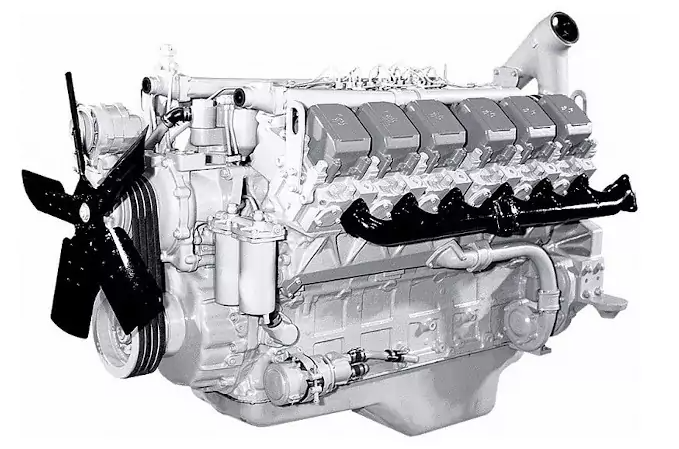
The YaMZ-240 engine was first put into production in the 1970s. It was the company’s first V-shaped, 12-cylinder heavy diesel engine. Some people erroneously think that the YaMZ-240 is only two “paired” 6-cylinder models rather than a fully independent V12 model. This is untrue; in addition to adding four more cylinders to the eight-cylinder engine, this family also changed the camber angle, the way the crankshaft’s main journals were supported, and a number of other innovative design elements.
Specifications
| Engine’s type | V-12 turbocharged |
| Production years | 1962 |
| Power output, kW at rpm | 205 at 2100 |
| Power output, hp at rpm | 300-500 at 2100 |
| Displacement, cc | 22299 |
| Number of cylinders | 12 |
| Valves | 24 |
| Torque output, Nm / rpm | 1275 at 2100 |
| Compression ratio | 16,5:1 |
| Cylinder bore, mm | 130 |
| Piston stroke, mm | 140 |
| Configuration | V |
| Fuel type | diesel |
| Fuel system | direct injection |
| Euro standards | Euro 0 |
| Cylinder head | OHV |
| Cooling | liquid |
YaMZ 240 engine design
The following functional blocks make up this engine model:
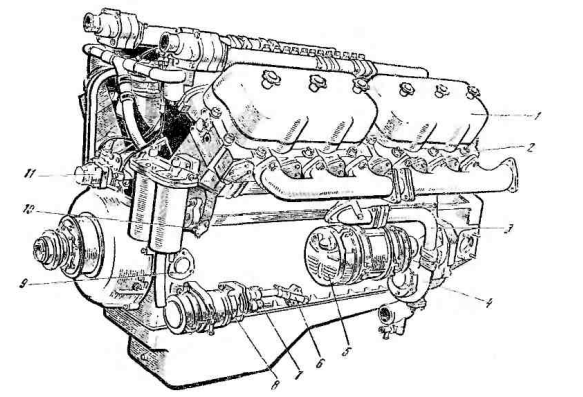
- Cylinder head cover;
- Cylinder head;
- Inlet pipe of the cooling system;
- Water pump;
- Generator;
- Shut-off valve;
- Angle flange for oil priming pump;
- Oil priming pump;
- Manhole cover;
- Water channel plug;
- Tachometer sensor.
In the same location as the upper portion of the crankcase, the cylinder block is situated in the upper portion of the cast housing. Twelve cylinders are used by the YaMZ-240. They are set up with convergence at the bottom in two rows of six pieces. The cylinders have a 75-degree tilt angle with respect to the central axis. The right row is pushed forward by 35 mm in relation to the left. This is because the crankshaft has two connecting rods installed on a single connecting rod journal, one for each of the right and left rows.
The block’s crankcase is a cast structure composed of gray low-alloy cast iron. Each sleeve has a hole in the upper portion. In addition, there is a camshaft sleeve, a high-pressure fuel pump, and a crankshaft. Depending on the modification, the cylinder heads can be found either individually or in blocks, each of which can accommodate three cylinders. Nozzles and spring valves with rocker arms are installed in the upper portion of each head.
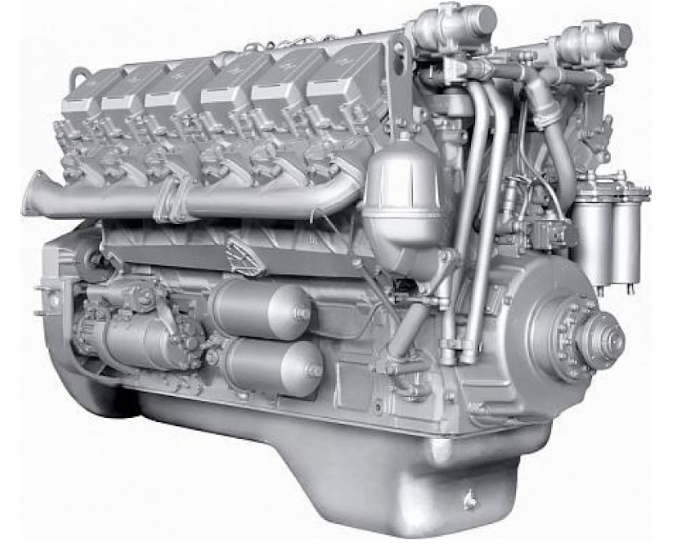
The YaMZ-240 motor’s crank mechanism consists of a crankshaft, a flywheel, and bearings. Hot-formed steel is used to make the crankshaft. There are seven round supports and six necks in the design. Although they are also composed of steel, the shaft journals are strengthened by electrocution during the production process. A thrust bearing is used to mount the shaft in the crankcase. Bronze rings are added to the bearing to strengthen the crankshaft retention and serve as seals. Through the leading edge, all machinery units and equipment receive power from the shaft.
Additionally, a vibration-dampening mechanism is installed here. A viscous liquid is the basis for how the damper operates. It is made up of a flywheel, fluid filler neck, die-cast body, and protective cover. A different metal plate is used to center the axle. The YaMZ 240 engines have fluid couplings that can support large loads in order to transfer high torque.
The YaMZ-240 diesel engine has a closed-type circulation cooling system installed. The coolant’s movement is the basis for the mechanism’s operation. The following nodes make up this scheme:
- centrifugal pump;
- left and right cylinder block cooling jackets;
- radiator;
- expansion tank for excess fluid;
- fan;
- remote thermometer.
The notch between the roller and the bushing allows the centrifugal pump to gather the liquid. When the working chamber has enough liquid in it, the device activates. A crankshaft-connected gear powers the pumping apparatus. The fan, which is powered by the crankshaft, creates air flows that allow the liquid to cool in the radiator. The liquid is uniformly distributed in the jackets after entering from the radiator. Pipes at the top of the heads allow hot water to be released after cooling. The expansion vessel has an opening through which the vapor building up in the line is released.
Engine repair and possible malfunctions
The engine has shown itself to be highly effective in both operation and repair. Only older YaMZ 240 models with shared heads (three cylinders each) may have repair issues. A new piston group, new exhaust and intake manifolds, new water pipes and pipes, new high pressure fuel pipes, a new block for separate heads, and new individual heads for each cylinder are just a few of the many new parts needed to repair such engines, which have become more challenging.
Even though the engine’s design is relatively straightforward by today’s standards, a lengthy production period allowed for the development of production technology. However, similar to another intricate mechanism, some malfunctions may happen while the engine is operating. The most prevalent ones are:
- breakdown of fuel equipment as a result of using poor-quality fuel or fuel that isn’t suitable for the operating season, as well as premature fuel filter replacement;
- early deterioration of the connecting rod-piston group as a result of improper lubricant use;
- the occurrence of unnecessary knocking brought on by a valve adjustment violation;
- reduction in power as a result of an air filter or exhaust tract blockage.