
Since 2013, the Volkswagen CHHB 2.0 TSI 220 horsepower 2.0-liter turbo engine has been manufactured and fitted to the top models of well-known cars like the Golf, Beetle, Passat, and Tiguan. A more potent 230 horsepower version of this power unit is available under the CHHA index.
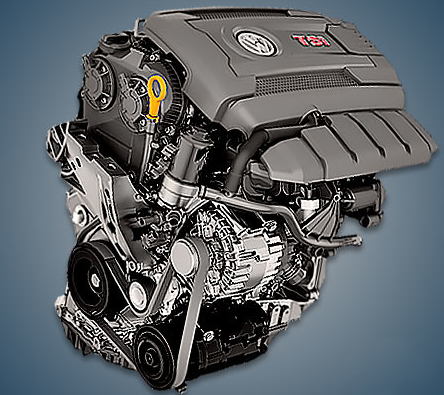
CJSA, CJSB, CJEB, CHHA, CHHB, CXDA, CNCD, and CJXC are all part of the EA888 gen3 series.
Specifications
| Production years | since 2013 |
| Displacement, cc | 1984 |
| Fuel system | FSI + MPI |
| Power output, hp | 220 |
| Torque output, Nm | 350 |
| Cylinder block | cast iron R4 |
| Block head | aluminum 16v |
| Cylinder bore, mm | 82.5 |
| Piston stroke, mm | 92.8 |
| Compression ratio | 9.6 |
| Features | DOHC, AVS |
| Hydraulic lifters | yes |
| Timing drive | chain |
| Phase regulator | on both shafts |
| Turbocharging | IHI IS20 |
| Recommended engine oil | 5W-30 |
| Engine oil capacity, liter | 5.7 |
| Fuel type | petrol |
| Euro standards | EURO 6 |
| Fuel consumption, L/100 km (for VW Passat 2017) — city — highway — combined |
7.6 5.5 6.3 |
| Engine lifespan, km | ~240 000 |
| Weight, kg | 140 |
The engine was installed on:
- Skoda Octavia 3 (5E) in 2013 – 2017;
- Skoda Superb 3 (3V) in 2015 – 2018;
- Volkswagen Golf 7 (5G) in 2013 – 2017;
- Volkswagen Beetle 2 (5C) in 2014 – 2018;
- Volkswagen Passat B8 (3G) in 2015 – 2018;
- Volkswagen Passat B8 Alltrack (3G5) since 2016;
- Volkswagen Tiguan 2 (AD) since 2016.
Disadvantages of the VW CHHB engine
Although the oil burner issue in this generation of engines is not particularly severe, there are still a lot of complaints;
The only way to totally eliminate lubricant consumption is to replace pistons with forged ones.
A decrease in oil pump performance is linked to significantly more breakdowns;
Reduced lubrication pressure causes camshafts and liners to wear down quickly;
The turbine pressure regulator needs to be adjusted every 50,000 kilometers;
The timing chain may stretch and the pump and phase regulators may fail up to 100,000 kilometers.