
Since 2016, the company has been producing the 2.0-liter Audi CVKB or A4 B9 2.0 TFSI turbo engine, which is installed on popular German models like the A4 or A5 in the B9 body. The motor runs on the Miller cycle and is a member of the economical series of gen3b power units.
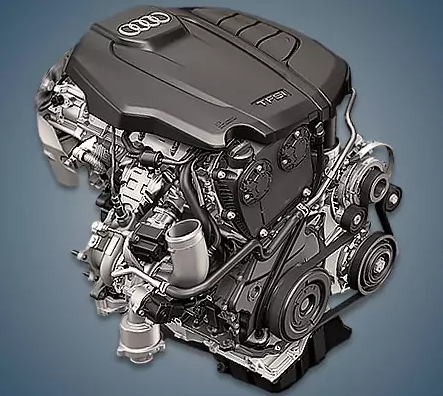
The EA888 gen3b series includes: CZPA, CZPB, DKZA, CVKB, CYRB, CYRC.
Specifications
| Production years | since 2016 |
| Displacement, cc | 1984 |
| Fuel system | FSI + MPI |
| Power output, hp | 190 |
| Torque output, Nm | 320 |
| Cylinder block | cast iron R4 |
| Block head | aluminum 16v |
| Cylinder bore, mm | 82.5 |
| Piston stroke, mm | 92.8 |
| Compression ratio | 11.6 |
| Features | AVS on the intake |
| Hydraulic lifters | yes |
| Timing drive | chain |
| Phase regulator | on both shafts |
| Turbocharging | IHI IS20 |
| Recommended engine oil | 0W-20 |
| Engine oil capacity, liter | 5.7 |
| Fuel type | petrol |
| Euro standards | EURO 6 |
| Fuel consumption, L/100 km (for Audi A4 2017) — city — highway — combined |
6.4 4.3 5.1 |
| Engine lifespan, km | ~250 000 |
| Weight, kg | 132 |
The engine was installed on:
- Audi A4 B9 (8W) since 2015;
- Audi A5 2 (F5) in 2016 – 2018.
Disadvantages of the Audi CVKB engine
Although the motor has shown itself to be reliable and each of the failures listed below is unique;
Low oil consumption from the first km of run has been complained about on specialized forums; closer to 120–150 thousand km, the timing chain is frequently stretched and needs to be replaced;
A plastic pump and an adjustable oil pump are two more engine flaws.