
The 1.8-liter Alfa Romeo AR32201, also known as the 1.8 Twin Spark engine, was built between 1997 and 2001 and fitted to popular concern models like the 145, 146, 156, GTV, and Spider. The motor’s index changed to AR32205 after it was updated to more recent Euro 3 environmental standards.
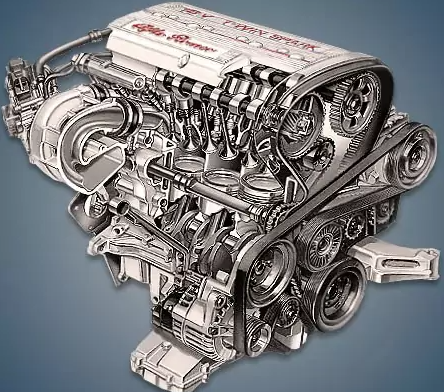
The Twin Spark line includes: AR32104, AR32201, AR32301, AR32310.
Specifications
| Production years | 1997-2001 |
| Displacement, cc | 1747 |
| Fuel system | distributed injection |
| Power output, hp | 144 |
| Torque output, Nm | 169 |
| Cylinder block | cast iron R4 |
| Block head | aluminum 16v |
| Cylinder bore, mm | 82 |
| Piston stroke, mm | 82.7 |
| Compression ratio | 10.3 |
| Features | DOHC, VLIM |
| Hydraulic lifters | yes |
| Timing drive | belt |
| Phase regulator | VVT at the intake |
| Turbocharging | no |
| Recommended engine oil | 10W-40 |
| Engine oil capacity, liter | 4.4 |
| Fuel type | petrol |
| Euro standards | EURO 2 |
| Fuel consumption, L/100 km (for Alfa Romeo 146 1999) — city — highway — combined |
11.7 6.5 8.4 |
| Engine lifespan, km | ~270 000 |
| Weight, kg | 160 |
The engine was installed on:
- Alfa Romeo 145 (Type 930) in 1998 – 2001;
- Alfa Romeo 146 (Type 930) in 1998 – 2001;
- Alfa Romeo 156 (Type 932) in 1997 – 2000;
- Alfa Romeo GTV II (Type 916) in 1998 – 2000;
- Alfa Romeo Spider V (Type 916) in 1998 – 2000.
Disadvantages of the Alfa Romeo AR32201 engine
This unit’s oil pump won’t last long if it doesn’t have a particular oil;
The resource of hydraulic lifters diminishes when the oil pump’s performance declines; the camshaft cams rapidly wear out as a result of the hydraulic lifters’ wedging; an oil burner frequently develops during extended runs as a result of stuck piston rings; and the motor’s weak points include an electronic throttle, a phase regulator, and a crankcase ventilation valve.