
Popular concern models with indexes 156 and 166, as well as the Lancia Lybra, were equipped with the 2.4-liter Alfa Romeo 839A6000 or Alfa Romeo 166 2.4 JTD engine, which was produced between 2000 and 2002. This device has a 10-valve SOHC cylinder head without any hydraulic lifters.
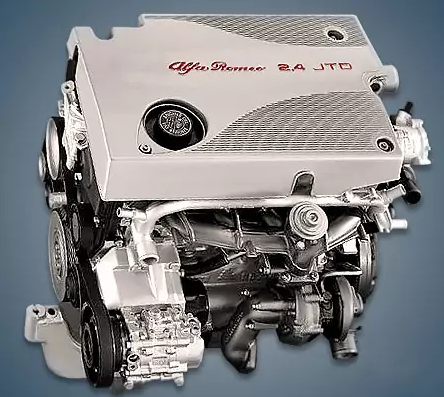
Multijet I family: 199A2000, 199A3000, 186A9000, 192A8000, 937A5000, 839A6000, 939A3000.
Specifications
| Production years | 2000-2002 |
| Displacement, cc | 2387 |
| Fuel system | Common Rail |
| Power output, hp | 140 |
| Torque output, Nm | 305 |
| Cylinder block | cast iron R5 |
| Block head | aluminum 10v |
| Cylinder bore, mm | 82 |
| Piston stroke, mm | 90.4 |
| Compression ratio | 18.45 |
| Features | SOHC, intercooler |
| Hydraulic lifters | no |
| Timing drive | belt |
| Phase regulator | no |
| Turbocharging | Garrett GTA2256V |
| Recommended engine oil | 5W-30 |
| Engine oil capacity, liter | 5.0 |
| Fuel type | diesel |
| Euro standards | EURO 3 |
| Fuel consumption, L/100 km (for Alfa Romeo 166 2001) — city — highway — combined |
9.7 5.8 7.2 |
| Engine lifespan, km | ~400 000 |
| Weight, kg | 210 |
The engine was installed on:
- Alfa Romeo 156 (Type 932) in 2000 – 2001;
- Alfa Romeo 166 (Type 936) in 2000 – 2002;
- Lancia Lybra I (839) in 2000 – 2002.
Disadvantages of the Alfa Romeo 839A6000 engine
Numerous issues with this straightforward and dependable motor are brought on by subpar wiring.
A booster pump, an EGR valve, and a mass air flow sensor are also very problematic here.
Strong vibrations from the engine typically mean that one of the injectors has started to pour.
The turbine functions well; frequently, the system that modifies its geometry is the only thing that malfunctions.
The oil pump chain’s lack of durability is another flaw in diesel engines.