
From 1995 to 2000, a German company assembled the 1.6-liter Opel X16SZR engine, which was installed on the basic modifications of well-known company models like the Astra and Vectra. A somewhat less potent version of this device was also available under the X16SZ index until 1996.
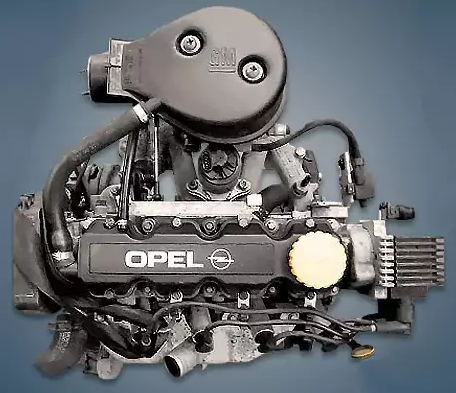
X12XE, X14XE, X16XEL, X16SZR, X18XE, and X18XE1 are all part of the X10 line.
The engine was mounted on:
- Opel Astra F (T92) in 1996 – 2000; Astra G (T98) in 1998 – 2000;
- Opel Vectra B (J96) in 1995 – 2000.
Specifications
| Production years | 1995-2000 |
| Displacement, cc | 1598 |
| Fuel system | single injection |
| Power output, hp | 75 |
| Torque output, Nm | 128 |
| Cylinder block | cast iron R4 |
| Block head | aluminum 8v |
| Cylinder bore, mm | 79 |
| Piston stroke, mm | 81.5 |
| Compression ratio | 9.6 |
| Features | no |
| Hydraulic lifters | yes |
| Timing drive | belt |
| Phase regulator | no |
| Turbocharging | no |
| Recommended engine oil | 5W-30 |
| Engine oil capacity, liter | 3.50 |
| Fuel type | petrol |
| Euro standards | EURO 2 |
| Fuel consumption, L/100 km (for Opel Astra 2000) — city — highway — combined |
9.7 5.8 7.3 |
| Engine lifespan, km | ~350 000 |
| Weight, kg | 100 |
Disadvantages of the X16SZR engine
Although this unit is frequently chastised for its low power, everything is reliable;
A dirty EGR valve is typically the cause of traction dips and floating engine speeds.
Oil leaks and ignition system component failures are examples of minor engine failures. The timing belt is limited to 60,000 kilometers, but when it breaks, the valves never bend.