
The 2.2-liter Opel Y22DTR or L50 diesel engine was manufactured between 2000 and 2005 and fitted several of the company’s well-known models, including the Astra, Vectra, Signum, and Zafira. When it came to diesel engines, this unit was the biggest and most potent of its kind.
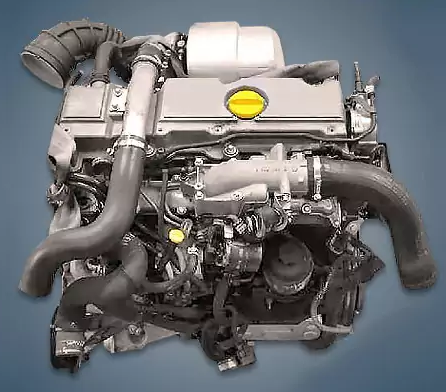
The engines Y17DT, Y20DTH, and Y22DTH are also members of the Y family.
The engine was mounted on:
- Opel Astra G (T98) in 2002 – 2005;
- Opel Signum A (Z03) in 2003 – 2004;
- Opel Vectra B (J96) in 2000 – 2002; Vectra C (Z02) in 2002 – 2004;
- Opel Zafira A (T98) in 2001 – 2005.
Specifications
| Production years | 2000-2005 |
| Displacement, cc | 2171 |
| Fuel system | direct injection |
| Power output, hp | 120 – 125 |
| Torque output, Nm | 270 – 280 |
| Cylinder block | cast iron R4 |
| Block head | aluminum 16v |
| Cylinder bore, mm | 84 |
| Piston stroke, mm | 98 |
| Compression ratio | 18.5 |
| Features | intercooler |
| Hydraulic lifters | yes |
| Timing drive | chain |
| Phase regulator | no |
| Turbocharging | VGT |
| Recommended engine oil | 5W-40 |
| Engine oil capacity, liter | 5.5 |
| Fuel type | diesel |
| Euro standards | EURO 3 |
| Fuel consumption, L/100 km (for Opel Vectra 2003) — city — highway — combined |
8.2 4.7 6.0 |
| Engine lifespan, km | ~350 000 |
| Weight, kg | 195 |
Disadvantages of the Y22DTR engine
An Opel owner with one of these engines spends their entire life fighting to keep the system from airing.
The control transistor frequently burns, and the high-pressure fuel pump electrician is unreliable.
They have long-lasting timing chains, but their guide rails are far weaker.
The crankshaft frequently breaks at high mileage due to issues with the lubrication of the liners.
The EGR valve and diesel particulate filter both quickly become dirty, just like in any diesel engine.