
Only the third generation of the well-liked Starlet model in Japan had the 1.3-liter Toyota 2E-TE turbo engine installed in the rear of the P70. The engine was assembled at the company’s factory between 1986 and 1989. This engine’s version with an exhaust catalyst is referred to by its own index, 2E-TELU.
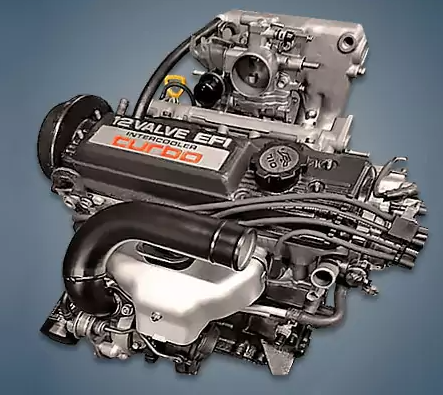
The engines in the E 1.3 L family are 2E, 2E-E, 2E-TE, 4E-FE, and 4E-FTE.
The engine was mounted on:
- Toyota Starlet 3 (P70) in 1986 – 1989.
Specifications
| Production years | 1986-1989 |
| Displacement, cc | 1295 |
| Fuel system | injector |
| Power output, hp | 100 – 110 |
| Torque output, Nm | 150 – 160 |
| Cylinder block | cast iron R4 |
| Block head | aluminum 12v |
| Cylinder bore, mm | 73 |
| Piston stroke, mm | 77.4 |
| Compression ratio | 8.0 |
| Features | SOHC |
| Hydraulic lifters | no |
| Timing drive | belt |
| Phase regulator | no |
| Turbocharging | yes |
| Recommended engine oil | 5W-30 |
| Engine oil capacity, liter | 3.2 |
| Fuel type | petrol |
| Euro standards | EURO 2 |
| Fuel consumption, L/100 km (for Toyota Starlet 1988) — city — highway — combined |
9.1 6.4 7.8 |
| Engine lifespan, km | ~200 000 |
| Weight, kg | 110 |
Disadvantages of the Toyota 2E-TE engine
First of all, there are issues with service and replacement parts, and this motor is extremely uncommon;
The engine is prone to overheating, and the cylinder head gasket frequently burns out;
Here, lubricant consumption occurs and valve stem seals are tanned for the same reason;
Piston rings lie after 100,000 kilometers, which again causes oil burn; ignition system problems cause owners a lot of headaches.