
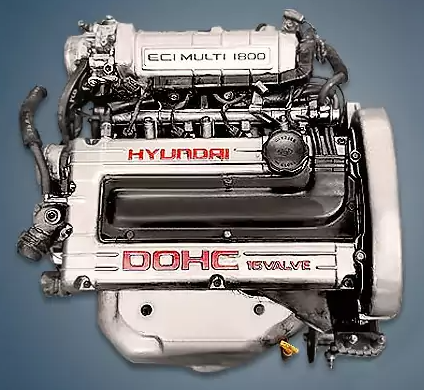
Since the 1.8-liter Hyundai G4CN engine was a full replica of the Mitsubishi power unit with the 4G67 index by design, it was assembled under license in South Korea from 1992 to 1998. In many markets, this DOHC engine is most recognized for its premium Lantra.
Sirius family: 1.6 L-G4CR; 1.8 L-G4CN, G4CM, G4JN; 2.0 L-G4CP, G4JP; 2.4 L-G4JS, G4CS.
The engine was mounted on:
- Hyundai Lantra 1 (J1) in 1992 – 1995;
- Hyundai Sonata 3 (Y3) in 1993 – 1998.
Specifications
| Production years | 1992-1998 |
| Displacement, cc | 1836 |
| Fuel system | injector |
| Power output, hp | 126 |
| Torque output, Nm | 165 |
| Cylinder block | cast iron R4 |
| Block head | aluminum 16v |
| Cylinder bore, mm | 81.5 |
| Piston stroke, mm | 88 |
| Compression ratio | 9.2 |
| Features | no |
| Hydraulic lifters | yes |
| Timing drive | belt |
| Phase regulator | no |
| Turbocharging | no |
| Recommended engine oil | 10W-40 |
| Engine oil capacity, liter | 3.7 |
| Fuel type | petrol |
| Euro standards | EURO 1/2 |
| Fuel consumption, L/100 km (for Hyundai Lantra 1994) — city — highway — combined |
9.4 7.2 8.1 |
| Engine lifespan, km | ~300 000 |
| Weight, kg | 150.8 (without attachments) |
Disadvantages of the Hyundai G4CN engine
Keep an eye on the balancer belt’s condition; if it breaks, it falls beneath the timing belt.
A broken timing belt and a collision between valves and pistons are typically the results of all of this.
The speed begins to float as soon as the throttle and idle speed controller become dirty.
Here, cutting lubrication frequently results in hydraulic lifter failure.
Weak engine mounts and an unreliable fuel pump are other complaints from owners.