
Only the fourth generation Golf, the comparable Bora, and the compact Lupo were equipped with the 1.4-liter Volkswagen AKQ 16v gasoline engine, which was manufactured between 1997 and 2000. This power unit is an AXP-indexed EURO 2 version of the more popular motor.
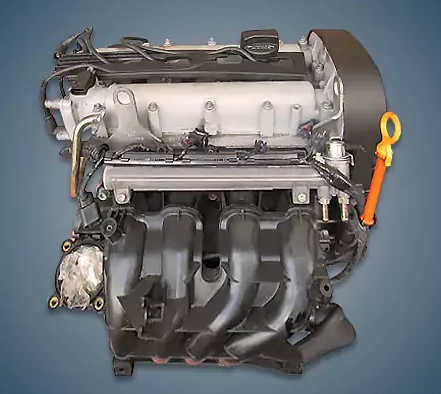
AEX, AKQ, AXP, BBY, BCA, BUD, CGGA, and CGGB are all part of the EA111-1.4 series.
Specifications
| Production years | 1997-2000 |
| Displacement, cc | 1390 |
| Fuel system | injector |
| Power output, hp | 75 |
| Torque output, Nm | 126 |
| Cylinder block | aluminum R4 |
| Block head | aluminum 16v |
| Cylinder bore, mm | 76.5 |
| Piston stroke, mm | 75.6 |
| Compression ratio | 10.5 |
| Features | DOHC |
| Hydraulic lifters | yes |
| Timing drive | 2 belts |
| Phase regulator | no |
| Turbocharging | no |
| Recommended engine oil | 5W-30 |
| Engine oil capacity, liter | 3.2 |
| Fuel type | petrol |
| Euro standards | EURO 2 |
| Fuel consumption, L/100 km (for VW Golf 4 2001) — city — highway — combined |
8.5 5.4 6.5 |
| Engine lifespan, km | ~250 000 |
The engine was installed on:
- Volkswagen Bora 1 (1J) in 1998 – 2000;
- Volkswagen Golf 4 (1J) in 1997 – 2000;
- Volkswagen Lupo 1 (6X) in 1998 – 2000.
Disadvantages of the VW AKQ engine
This unit’s poor dependability and loud operation are frequently criticized on specialized forums.
Throttle assembly malfunctions are the most common source of issues for owners.
In winter, oil is frequently forced out through the dipstick due to the crankcase ventilation freezing.
Keep an eye on the timing belts’ condition; if they break, the valves will bend.
Over a distance of over 100,000 kilometers, rings frequently lie and oil consumption is evident.