
From 2002 to 2009, the company assembled the 4.2-liter Jaguar AJ33S 4.2 Supercharged engine and installed charged versions of well-known models like the XKR, XJR, or S-Type R. The Land Rover 428PS compressor engine was developed based on this power unit.
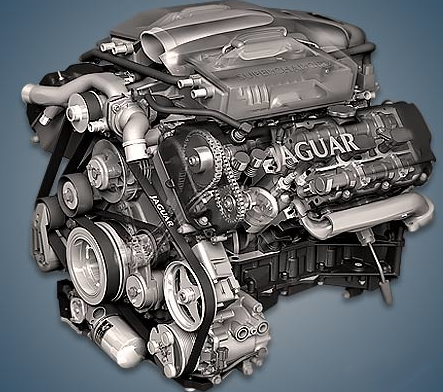
AJ-V8 series: AJ126, AJ27, AJ27S, AJ28, AJ33, AJ33S, AJ34, AJ34S, AJ133, and AJ133S.
Specifications
| Production years | 2002-2009 |
| Displacement, cc | 4196 |
| Fuel system | distributed injection |
| Power output, hp | 395 |
| Torque output, Nm | 540 |
| Cylinder block | aluminum V8 |
| Block head | aluminum 32v |
| Cylinder bore, mm | 86 |
| Piston stroke, mm | 90.3 |
| Compression ratio | 9.1 |
| Features | intercooler |
| Hydraulic lifters | no |
| Timing drive | chain |
| Phase regulator | yes |
| Turbocharging | Eaton M112 |
| Recommended engine oil | 5W-30 |
| Engine oil capacity, liter | 7.0 |
| Fuel type | petrol |
| Euro standards | EURO 3 |
| Fuel consumption, L/100 km (for Jaguar S-Type R 2007) — city — highway — combined |
18.5 9.2 12.5 |
| Engine lifespan, km | ~350 000 |
The engine was installed on:
- Jaguar S-Type 1 (X200) in 2002 – 2007;
- Jaguar XJ 7 (X350) in 2003 – 2009;
- Jaguar XK 1 (X100) in 2002 – 2006.
Disadvantages of the Jaguar AJ33S engine
Keep an eye on the cooling system because this aluminum motor is afraid of overheating;
A tiny resource is available to the compressor water pump;
Here, the crankcase ventilation valve rapidly clogs, resulting in a significant lubricant consumption;
The engine speed will float if the throttle and injectors are not cleaned on a regular basis; additionally, different nozzles frequently burst, causing air leaks.