
Since 2009, the company’s plant has been assembling the Jaguar AJV6D 3.0-liter V6 diesel engine, which is still found in many of the British company’s well-known models, including the XJ, XF, and F-Pace. Land Rover SUVs have the same power unit installed, but it is identified by the symbol 306DT. This motor is a type of 3.0 HDi diesel engine.
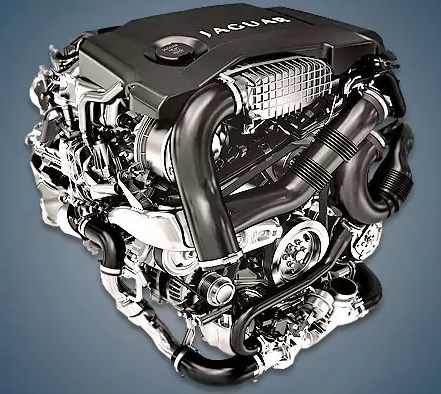
Specifications
| Production years | since 2009 |
| Displacement, cc | 2993 |
| Fuel system | Common Rail |
| Power output, hp | 240 – 300 |
| Torque output, Nm | 500 – 700 |
| Cylinder block | cast iron V6 |
| Block head | aluminum 24v |
| Cylinder bore, mm | 84 |
| Piston stroke, mm | 90 |
| Compression ratio | 16.1 |
| Features | DOHC |
| Hydraulic lifters | yes |
| Timing drive | chains & belt |
| Phase regulator | no |
| Turbocharging | Garrett GTB1749VK + GT1444Z |
| Recommended engine oil | 5W-30 |
| Engine oil capacity, liter | 5.9 |
| Fuel type | diesel |
| Euro standards | EURO 4/5 |
| Fuel consumption, L/100 km (for Jaguar XF 2018) — city — highway — combined |
7.0 5.2 5.9 |
| Engine lifespan, km | ~280 000 |
The engine was installed on:
- Jaguar XF 1 (X250) in 2009 – 2015; XF 2 (X260) since 2015;
- Jaguar XJ 8 (X351) in 2009 – 2019;
- Jaguar F-Pace 1 (X761) since 2016.
Disadvantages of the Jaguar AJV6D engine
Lubrication pressure is a factor in almost every issue with this diesel engine;
Early on, a weak oil pump was installed, which caused the liners to crank; the pump was later replaced, but careful monitoring of the oil pressure is still necessary;
Additionally, grease frequently seeps through the front crankshaft oil seal and heat exchanger;
Piezo injectors and a plastic intake manifold are the motor’s weak points.