
The Grand Cherokee SUV and, for a brief period, Ram or Dakota pickups were equipped with the 4.7-liter V8 Jeep EVC or PowerTech High Output engine, which was manufactured between 2002 and 2008. In addition to having more power than its equivalent, the motor had a knock sensor.
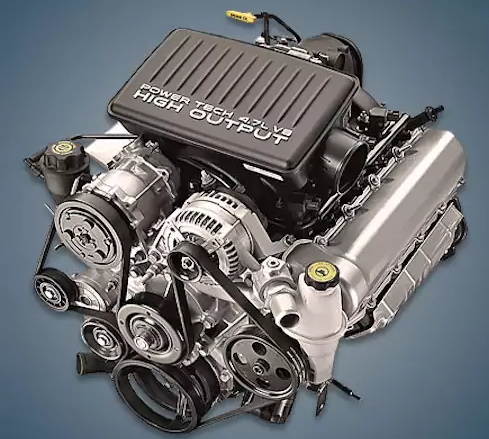
The EKG, EVA, and EVE internal combustion engines are also part of the PowerTech series.
The engine was mounted on:
- Dodge Dakota 3 (ND) in 2007 – 2008;
- Dodge Ram 3 (DT) in 2007 – 2008;
- Jeep Grand Cherokee 2 (WJ) in 2002 – 2004;
- Jeep Grand Cherokee 3 (WK) in 2007 – 2008.
Specifications
| Production years | 2002-2008 |
| Displacement, cc | 4701 |
| Fuel system | injector |
| Power output, hp | 255 – 265 |
| Torque output, Nm | 420 – 450 |
| Cylinder block | cast iron V8 |
| Block head | aluminum 16v |
| Cylinder bore, mm | 93 |
| Piston stroke, mm | 86.5 |
| Compression ratio | 9.7 |
| Features | SOHC |
| Hydraulic lifters | yes |
| Timing drive | chain |
| Phase regulator | no |
| Turbocharging | no |
| Recommended engine oil | 5W-30 |
| Engine oil capacity, liter | 5.7 |
| Fuel type | petrol |
| Euro standards | EURO 3/4 |
| Fuel consumption, L/100 km (for Jeep Grand Cherokee 2002) — city — highway — combined |
22.3 12.0 15.0 |
| Engine lifespan, km | ~300 000 |
Disadvantages of the EVC engine
The engine needs particular oils to avoid clogging its small oil passageways;
Additionally, hydraulic lifters frequently stick here as a result of improper lubricant selection;
Periodically, but much less frequently, valve seats are lost;
Three chains with a 200,000 km resource make up timing; however, your primary costs will be related to excessively high fuel consumption.