
AMG versions of the C-Class, CL-Class, E-Class, S-Class, and SL-Class were equipped with the 6.3-liter V8 Mercedes M156 engine, which was manufactured at a plant in Germany between 2006 and 2015. A dry sump version of this engine was available for sports cars under the M159 designation.
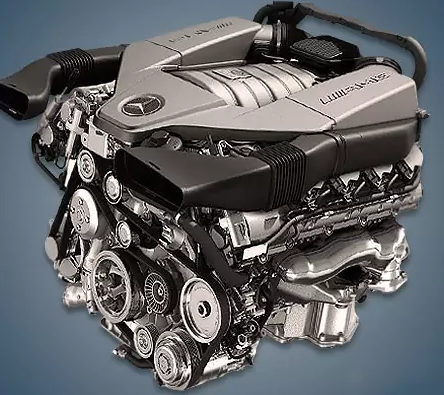
M113 E43, M113 E50, M113 E55, M119 E42, M119 E50, M119 E60, M156, M157, M177, M273, and M278 are all members of the V8-family.
Specifications M156 E63
| Production years | 2006 – 2015 |
| Displacement, cc | 6208 |
| Fuel system | injector |
| Power output, hp | 457 – 525 |
| Torque output, Nm | 600 – 630 |
| Cylinder block | aluminum V8 |
| Block head | aluminum 32v |
| Cylinder bore, mm | 102.2 |
| Piston stroke, mm | 94.6 |
| Compression ratio | 11.3 |
| Features | DOHC |
| Hydraulic lifters | yes |
| Timing drive | chain |
| Phase regulator | on all shafts |
| Turbocharging | no |
| Recommended engine oil | 0W-40 |
| Engine oil capacity, liter | 9.0 |
| Fuel type | petrol |
| Euro standards | EURO 4/5 |
| Fuel consumption, L/100 km (for Mercedes E63 AMG 2008) — city — highway — combined |
22.3 9.8 14.3 |
| Engine lifespan, km | ~250 000 |
| Weight, kg | 199 |
The engine was installed on:
- Mercedes C-Class W204 in 2007 – 2015;
- Mercedes CL-Class C216 in 2006 – 2010;
- Mercedes CLK-Class C209 in 2006 – 2010;
- Mercedes CLS-Class W219 in 2006 – 2010;
- Mercedes E-Class W211 in 2006 – 2009; E-Class W212 in 2009 – 2011;
- Mercedes ML-Class W164 in 2006 – 2010;
- Mercedes R-Class W251 in 2006 – 2007;
- Mercedes S-Class W221 in 2006 – 2010;
- Mercedes SL-Class R230 in 2008 – 2011.
Disadvantages of the Mercedes M156 engine
Low camshaft life is the most well-known issue with these engines;
The owners even filed a class action lawsuit as a result, but it was dismissed;
The wedge of the plunger pair in hydraulic compensators is thought to be the primary cause of this; occasionally, the valves break apart from the impact and fall straight into the cylinders;
The short-lived head bolts are another known weakness in this situation.
Antifreeze leaks were caused by rotted bolt heads in units prior to 2011, and until 2015, camshaft sprocket wear issues affected all engines.