
Since 2000, factories in Japan and the USA have assembled the 2.5-liter Nissan QR25DE engine, also known as QR25 for short, which is installed on well-known concern models like the Altima, Caravan, Frontier, and X-Trail. Some differentiate between its two generations because the engine underwent a significant upgrade in 2007.
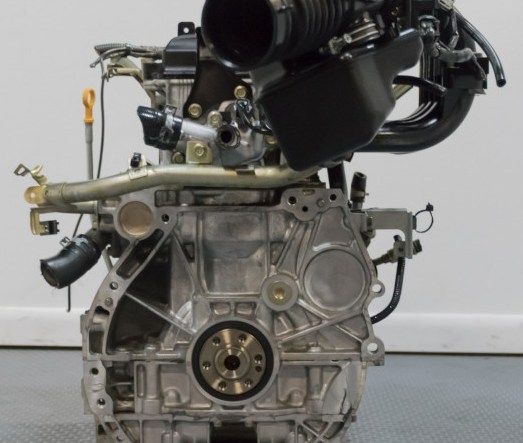
An aluminum 4-cylinder block with cast-iron liners and an open cooling jacket, an aluminum 16-valve cylinder head without hydraulic compensators and an inlet phase control system, a timing drive with a leaf chain, individual ignition coils, and block balancers made up this distributed fuel injection engine’s rather innovative design.
An impressive array of modifications, including additional pistons, camshafts, an intake manifold, a block of balancer shafts moved to the center, more support, and an additional anti-friction coating for friction surfaces, were added to this motor when it was updated in 2007. Dephasers were installed on both camshafts in the most recent iterations of this engine.
Owners give the QR25DE a low rating. With a mileage of slightly over 200 and a very watchful and cautious attitude, it is pronounced “one-time.” The engine emerged as a result of the two-liter QR20DE’s piston stroke being significantly expanded (by 20 mm) and the crankshaft and camshaft being replaced at the exhaust. Although resource depletion and oil issues are more prevalent here, the engine has significantly improved since 2007.
QR20DE, QR20DD, QR25DE, QR25DD, and QR25DER are members of the QR family.
Specifications
| Manufacturer | Yokohama Plant Nissan Decherd Powertrain Plant |
| Production years | since 2000 |
| Cylinder block alloy | aluminum |
| Fuel system | distributed injection |
| Configuration | inline |
| Number of cylinders | 4 |
| Valves per cylinder | 4 |
| Piston stroke, mm | 100 |
| Cylinder bore, mm | 89 |
| Compression ratio | 9.1 9.5 10.5 |
| Displacement, cc | 2488 |
| Power output, hp | 152/5200 160/5600 173/6000 178/6000 182/6000 200/6600 250/5600 |
| Torque output, Nm / rpm | 245/4400 240/4000 234/4000 244/4000 244/4000 244/5200 329/3600 |
| Fuel type | petrol |
| Euro standards | Euro 3/4 |
| Weight, kg | 121 |
| Fuel consumption, L/100 km (for Nissan X-Trail 2005) — city — highway — combined |
12.6 7.6 9.4 |
| Oil consumption, gr/1000 km | up to 500 |
| Recommended engine oil | 5W-30, 5W-40 |
| Engine oil capacity, liter | 5.1 |
| Oil change interval, km | 15000 |
| Normal engine operating temperature, °C | ~90 |
| Engine lifespan, km | ~300 000 |
The engine was installed on:
- Nissan Altima 3 (L31) in 2001 – 2006; Altima 4 (L32) in 2006 – 2013; Altima 5 (L33) in 2012 – 2018;
- Nissan Bassara 1 (JU30) in 2000 – 2003;
- Nissan Caravan 5 (E25) in 2007 – 2012; Caravan 6 (E26) since 2012;
- Nissan Frontier 2 (D40) in 2004 – 2021; Frontier 3 (D23) since 2014;
- Nissan Murano 1 (Z50) in 2002 – 2007; Murano 2 (Z51) in 2007 – 2014;
- Nissan Presage 1 (U30) in 2001 – 2003; Presage 2 (U31) in 2003 – 2009;
- Nissan Rogue 1 (S35) in 2007 – 2015; Rogue 2 (T32) in 2013 – 2020;
- Nissan Sentra 5 (B15) in 2001 – 2006; Sentra 6 (B16) in 2006 – 2012;
- Nissan Serena 2 (C24) in 2001 – 2005;
- Nissan Elgrand 3 (E52) since 2010;
- Nissan Teana 2 (J32) in 2008 – 2013; Teana 3 (L33) in 2013 – 2020;
- Nissan Terra 1 (D23) since 2018;
- Nissan X-Trail 1 (T30) in 2000 – 2007; X-Trail 2 (T31)in 2007 – 2014; X-Trail 3 (T32) in 2013 – 2022;
- Renault Koleos 1 (HY) in 2007 – 2016; Koleos 2 (HC) since 2016;
- Suzuki Equator 1 (D40) in 2008 – 2012.
Disadvantages of the QR25DE engine
Prior to 2004, motors were outfitted with weak catalysts that collapsed easily, drawing their crumbs into the combustion chambers. Additionally, up until 2006, engines had an intake manifold with turbulator flaps; if the bolts were unscrewed, the flaps fell into the cylinders with similar results.
The majority of these units’ owners’ grievances have something to do with the oil burner. In addition to cylinder scuffing, the causes include thin oil scraper rings, which frequently appear even after 100,000 kilometers, and wear on the valve stem seals. The offenders are also joined by a sizable ellipse of cylinders on long runs.
Additionally, the Morse thin plate chain is not the best resource here; at 150,000 kilometers, it can stretch dangerously and begin to produce a lot of noise. Although you can just wash it, it is frequently advised to swap out the phase regulator for the chain.
The cylinder head gasket’s frequent failure is another frequent issue here. Usually, dirty radiators or a malfunctioning thermostat are to blame. In this instance, head deformation and occasionally the emergence of microcracks are common.
Unreliable camshaft and crankshaft position sensors, a rather clumsy electric throttle, and perpetually flowing candle well seals cause a lot of problems. Additionally, since there are no hydraulic compensators here, remember to modify the thermal clearances of the valves.