
Since 2014, the company has been producing the 1.2-liter Peugeot EB2DTS or HNY turbo engine, which is installed on all of the company’s compact and medium-sized models under the PureTech 130 indices. This power unit has several modifications, including EB2DTSD, EB2DTSM, and EB2ADTS.
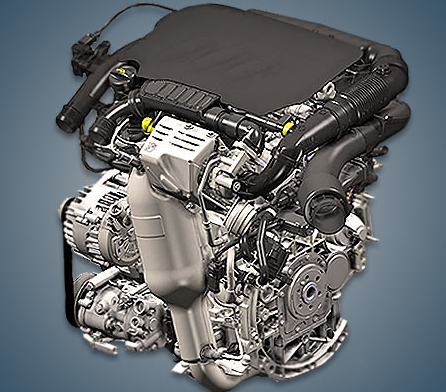
The EB family of engines includes EB0, EB2, EB2M, EB2DT, EB2DTS, and EB2ADTX.
Specifications
| Production years | since 2014 |
| Displacement, cc | 1199 |
| Fuel system | direct injection |
| Power output, hp | 130 |
| Torque output, Nm | 230 |
| Cylinder block | aluminum R3 |
| Block head | aluminum 12v |
| Cylinder bore, mm | 75 |
| Piston stroke, mm | 90.5 |
| Compression ratio | 10.5 |
| Features | balancers |
| Hydraulic lifters | no |
| Timing drive | belt |
| Phase regulator | dual VTi |
| Turbocharging | Garrett NGT1341LSZ |
| Recommended engine oil | 0W-30 |
| Engine oil capacity, liter | 3.5 |
| Fuel type | petrol |
| Euro standards | EURO 6 |
| Fuel consumption, L/100 km (for Peugeot 308 2015) — city — highway — combined |
5.8 4.0 4.6 |
| Engine lifespan, km | ~250 000 |
| Weight, kg | 99 |
The engine was installed on:
- Citroen Berlingo III (K9) since 2019;
- Citroen C3 Aircross II (A88) since 2017;
- Citroen C4 II (B71) in 2014 – 2018; C4 III (C41) since 2020;
- Citroen C4 Cactus II (F3) in 2018 – 2020;
- Citroen C4 Picasso II (B78) since 2015;
- Citroen C5 Aircross I (C84) since 2019;
- Citroen DS4 I (B75) in 2014 – 2015;
- DS DS3 II (D34) since 2018;
- DS DS4 I (B75) in 2015 – 2018; DS4 II (D41) since 2021;
- DS DS7 I (X74) since 2018;
- Opel Combo E (X19) since 2019;
- Opel Corsa F (P2JO) since 2019;
- Opel Crossland X (P17) since 2017;
- Opel Grandland X (A18) since 2017;
- Opel Mokka B (P2QO) since 2021;
- Peugeot 208 I (A9) since 2019;
- Peugeot 308 II (T9) in 2014 – 2021; 308 III (P5) since 2021;
- Peugeot 508 II (R8) since 2020;
- Peugeot 2008 I (A94) in 2015 – 2019; 2008 II (P24) since 2019;
- Peugeot 3008 I (T84) in 2015 – 2016; 3008 II (P84) since 2016;
- Peugeot 5008 I (T87) in 2015 – 2017; 5008 II (P87) since 2017;
- Peugeot Rifter I (K9) since 2019.
Disadvantages of the EB2DTS engine
The primary design flaw of the unit is the timing belt in an oil bath; it does not serve the prescribed 180,000 km and its wear products clog the oil channels. Additionally, many owners complain about lubricant consumption for a run of 100–120 thousand km. Crankshaft axial play caused a recall campaign for turbo engines in the early years of production.