
Nearly all of the French company’s mass models came equipped with the 1.6-liter Peugeot EP6CDT or THP 16V 156 turbo engine, which was first introduced in 2009. This unit was modified in three ways: 5FA for 125 horsepower, 5FN for 150 horsepower, and 5FV for 156 horsepower.
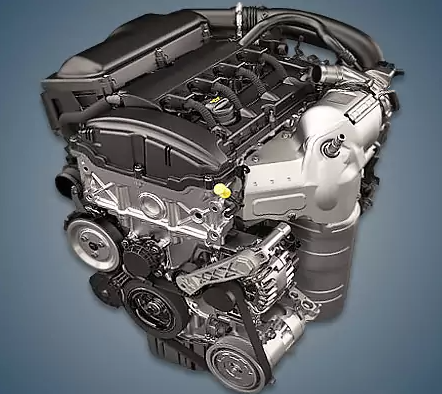
The Prince family of turbo engines includes the EP6DT, EP6DTS, EP6CDT, EP6CDTM, EP6CDTR, EP6CDTX, EP6FDT, EP6FDTM, and EP6FDTR.
The company released an upgraded EP6DT motor under the EP6CDT index in 2009. An aluminum cylinder block with cast-iron liners, an aluminum 16-valve head with hydraulic lifters, and a timing chain drive served as the design’s foundation. This unit’s supercharging is accomplished by a strong TwinScroll BorgWarner K03 turbine with an intercooler. This engine lacks a valvetronic, in contrast to atmospheric engines, and the phase regulator is limited to the exhaust.
The updated EP6CDT motor differed from its predecessor, the EP6DT, primarily in that it had a different vacuum pump, a pump with an electromagnetic clutch, crankshaft liners with grooves to reduce friction, its own firmware, and a more advanced catalyst that allowed it to meet Euro 5 environmental standards. Additionally, the lubrication pressure sensor was eventually transferred from the head to the oil filter bracket.
Specifications
| Production years | since 2009 |
| Displacement, cc | 1598 |
| Fuel system | direct injection |
| Power output, hp | 125 (5FA or THP 125) 150 (5FN or THP 150) 156 (5FV or THP 156) |
| Torque output, Nm | 200 (5FA or THP 125) 240 (5FN or THP 150) 240 (5FV or THP 156) |
| Cylinder block | aluminum R4 |
| Block head | aluminum 16v |
| Cylinder bore, mm | 77 |
| Piston stroke, mm | 85.8 |
| Compression ratio | 10.5 |
| Hydraulic lifters | yes |
| Timing drive | chain |
| Phase regulator | at the exhaust |
| Turbocharging | TwinScroll |
| Recommended engine oil | 5W-30, 5W-40 |
| Engine oil capacity, liter | 4.25 |
| Fuel type | petrol |
| Euro standards | EURO 5 |
| Fuel consumption, L/100 km (for Peugeot 508 2012) — city — highway — combined |
10.5 5.9 7.1 |
| Engine lifespan, km | ~200 000 |
| Weight, kg | 137 |
The engine was installed on:
- Citroen C4 II (B71) in 2010 – 2014;
- Citroen C4 Picasso I (B58) in 2010 – 2013; C4 Picasso II (B78) in 2013 – 2014;
- Citroen C5 II (X7) in 2010 – 2015;
- Citroen DS3 I (A55) in 2010 – 2014;
- Citroen DS4 I (B75) in 2011 – 2012;
- Citroen DS5 I (B81) in 2011 – 2015;
- Peugeot 207 I (A7) in 2009 – 2015;
- Peugeot 208 I (A9) in 2012 – 2015;
- Peugeot 308 I (T7) in 2010 – 2015; 308 II (T9) in 2013 – 2015;
- Peugeot 3008 I (T84) in 2009 – 2015;
- Peugeot 5008 I (T87) in 2009 – 2015;
- Peugeot 508 I (W2) in 2011 – 2014;
- Peugeot RCZ I (T75) in 2010 – 2015.
Disadvantages of the EP6CDT engine
The primary issue with this motor is the direct injection system’s unreliable injection pump, which occasionally has a resource of less than 50,000 kilometers. Additionally, the intake valves here quickly become overgrown with soot and cease to close.
The updated engine has a slightly longer chain than its predecessor, but it is still insufficient; that is, it is now closer to 100,000 kilometers instead of 50,000. The availability of low-cost timing kits from different manufacturers is a good thing.
This motor was given a new oil pump that can change the pressure-flow rate, which frequently causes wedges. Additionally, the engine’s crankshaft liners and possibly the camshaft will pick up fairly quickly if this occurs in the minimum performance mode.
Overheating occurs frequently here due to the unreliability of the pump and thermostat. As a result, oil consumption shows up right away and valve stem seals rapidly tan in the cylinder head. Wear on the crankcase ventilation membrane or the development of piston rings could be the reason for the oil burner.
Coking of the lubricant in the intake manifold and oil supply pipes is caused by oil consumption and frequent overheating, which results in turbine failure and unstable engine operation. Additionally, this series’ motors frequently experience coolant and oil leaks.